Why Your Security System Needs Network Failover Protection
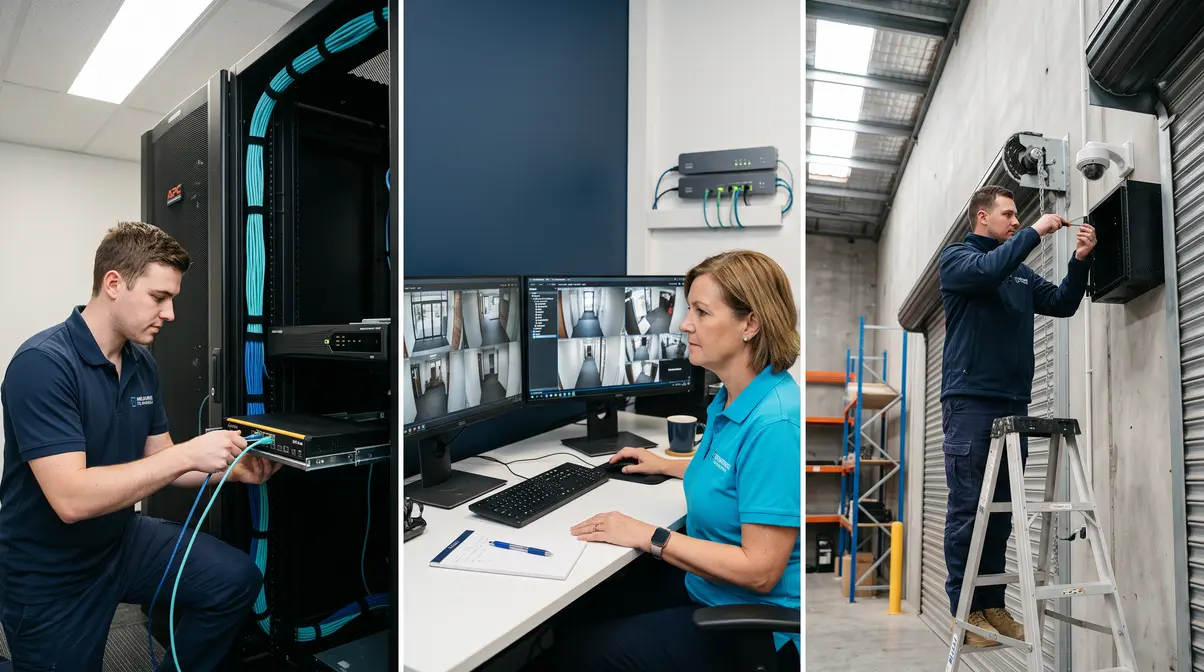
Ensure 24/7 uptime. Learn why your security system relies on network failover protection to stop costly blackouts and eliminate critical blind spots.
Table of Contents
Why Modern Commercial Security Demands Constant Connectivity
For modern commercial facilities across Western Australia, electronic security is no longer an isolated, analogue system operating within a closed loop. Today, commercial operations depend heavily on instant data transmission, cloud verification, and continuous offsite telecommunication. When an incident occurs outside standard operating hours, whether an unauthorised entry attempt in an industrial estate in Welshpool or a perimeter breach in an Osborne Park logistics depot, your physical security infrastructure must communicate instantly with offsite management, monitoring centres, and emergency responders. However, this critical capability introduces a single, catastrophic vulnerability: dependence on an uninterrupted primary internet connection.
Fixed-line broadband connections, including standard National Broadband Network (NBN) fibre and copper links, remain susceptible to severe real-world disruptions. Civil excavation works frequently sever underground conduits; severe Perth winter storms damage overhead lead-in cables; upstream carrier outages leave entire commercial subdivisions offline for hours or even days. In these moments, if a facility lacks automated network failover protection, its primary link to the outside world ceases to exist. While an unmonitored local setup might continue recording locally to an internal drive, its ability to notify small business managers, stream live incident feeds, or synchronise access permissions is instantly paralysed.
At Smart SYS, we architect infrastructure to eliminate this precise vulnerability. We observe firsthand how the lines between physical security and digital communications have merged. To protect commercial assets against opportunistic intrusions and logistical disruption, facilities require redundant, automated communication topologies. Understanding how redundant routing interacts with commercial hardware is the first step toward true operational resilience.
The Architecture of Network Failover Protection in Commercial Facilities
To understand the necessity of this infrastructure, we must examine how enterprise-grade network failover protection operates on site. In a standard commercial configuration, a primary wide area network (WAN) interface carries the facility’s day-to-day traffic. This encompasses internal VoIP telephone communications, staff collaboration tools, and the data generated by networked security hardware. When this primary gateway drops offline, a passive system simply halts. By contrast, automated failover uses intelligent gateway routing to continuously monitor link health via automated echo requests, latency checks, and packet loss metrics sent to upstream public DNS servers.
When the primary link fails to respond within a predetermined threshold—often measured in milliseconds—the gateway router initiates an automated state switch. This mechanism reroutes outbound and inbound traffic through an auxiliary WAN pathway, typically an industrial-grade 4G or 5G LTE cellular communicator. The process is completely autonomous, requiring zero manual intervention from facility staff or small business managers.
Deploying intelligent routers configured for stateful network failover protection ensures that ongoing network sessions do not terminate abruptly. Instead, the routing table updates dynamically, transferring active data sockets to the secondary cellular pipe. Once the primary fixed-line broadband connection demonstrates stability over an extended testing window, the system performs a graceful failback, shifting primary traffic back to the physical line while preserving secondary mobile data allowances.
For facilities operating multi-site networks across Perth and regional WA, integrating this redundant routing mechanism safeguards vital operational continuity. To delve deeper into the mechanical routing principles, read our technical breakdown on Failover Protection for Perth Security Systems: How It Works to see how our engineering team configures these pathways for harsh Australian environments.

Commercial CCTV and Access Control: The Vulnerability of Network Devices
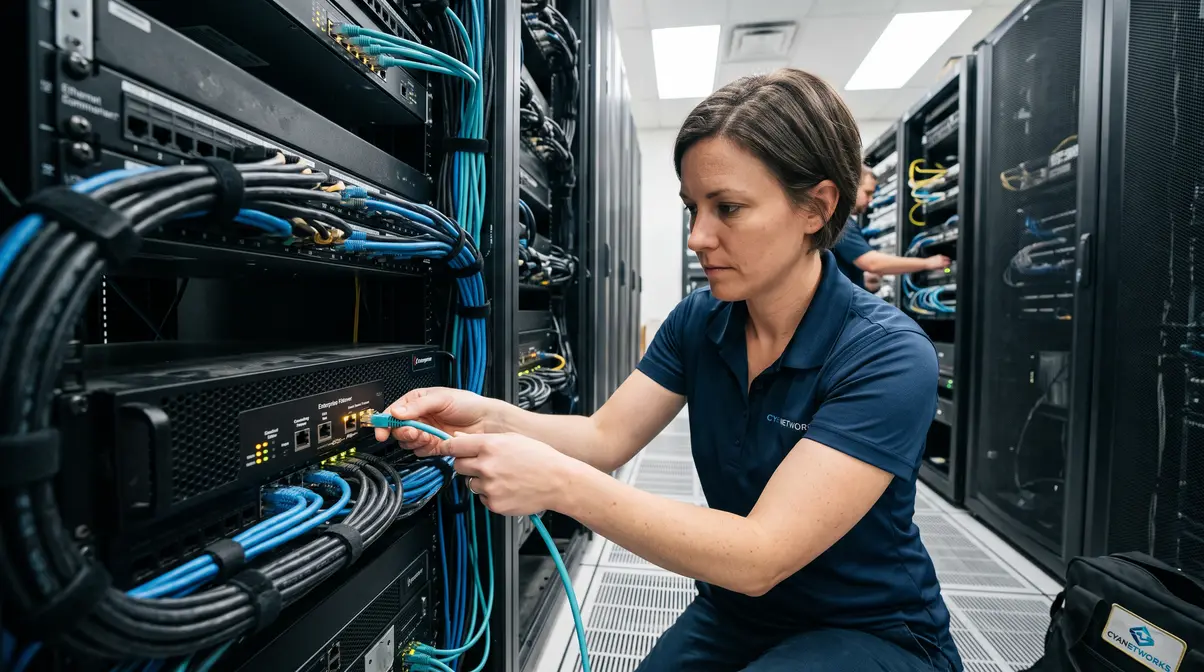
A critical technical distinction must be maintained when auditing commercial security assets: not all security devices interact with your local area network (LAN) in the same manner. Specifically, Commercial CCTV cameras and Commercial Access Control controllers are true network devices. They possess dedicated IP addresses, communicate via TCP/IP protocols over Cat5E or Cat6 Ethernet cable, consume network bandwidth, and rely on secure routing rules to execute their core operations.
High-quality CCTV systems provide clear, evidentiary-grade footage that supports accurate incident verification and liability protection. However, the operational utility of this evidentiary footage drops exponentially if offsite stakeholders cannot access the live video streams during an ongoing security incident. When a primary internet link fails without redundant routing:
- Offsite Network Video Recorder (NVR) backup streams fail instantly, leaving video evidence confined solely to onsite hardware vulnerable to physical theft or fire damage.
- Push notifications, automated motion triggers, and perimeter crossing tripwires cannot reach remote monitoring teams.
- Remote pan-tilt-zoom (PTZ) manipulation and two-way audio interventions are severed.
Similarly, modern commercial access control systems are true network devices that link electronic door strikes, RFID card readers, biometric scanners, and smart locks back to central access management servers. While local door controllers retain an internal cache of user credentials to allow physical card presentation during a drop, commercial access control and CCTV rely on robust network failover protection to maintain essential operational functions. Without active internet connectivity, administrators cannot remotely grant access to delivery couriers, revoke lost staff access fobs in real time, or receive instant notifications when an emergency door is forced open.
Conversely, commercial alarm panels require a different technical classification. We never categorise an alarm system as a network device. Traditional intrusion alarm panels communicate through independent, dedicated paths—such as integrated dual-SIM cellular diallers or direct copper lines—deliberately isolated from the local office LAN. While alarms do not rely directly on the office router, they work in tandem with our wider ecosystem. When an alarm triggers a perimeter breach, small business managers immediately turn to their commercial CCTV network devices to verify the threat. If the local internet connection is down and no redundant failover exists, visual verification becomes impossible, forcing costly, blind security patrol dispatches.
ICT Infrastructure as the Backbone of Electronic Security
Modern commercial security cannot survive on an island. It operates directly atop an organisation’s information and communications technology (ICT) framework. At Smart SYS, we operate on a proprietary Dual-Engine model, delivering comprehensive ICT Services alongside our advanced Security Services (CCTV, Alarms, Access Control). We recognise that the physical security of your commercial premises is directly constrained by the reliability of your communications network.
Our ICT services encompass critical operational infrastructure, including:
- Enterprise Telecommunication and SIP trunk routing
- Business-grade Voice over IP (VoIP) telephony
- Unified group communication platforms
- Real-time collaboration tools
- Structured network infrastructure (managed switching, VLAN segmentation, and enterprise routing)
In traditional commercial fit-outs, small business managers hire an IT contractor to deploy the office router and VoIP phones, and an entirely separate electronic security company to install cameras and access control. When an internet dropout blinds the security cameras or causes the VoIP phone system to crash, a costly and frustrating blame game inevitably begins. The security technician blames the IT provider’s firewall, while the IT contractor blames the security installer’s camera bandwidth.
We eliminate this friction entirely. Our USP as a Single Point of Accountability means that our specialists engineer the telecommunication routing, the physical network switches, and the commercial surveillance devices concurrently. By embedding network failover protection across both IT and electronic security domains, we assure that our clients deal with one engineering partner responsible for the entire data pathway. When an outage occurs, our automated multi-WAN architectures sustain both business-critical VoIP calls and high-bandwidth CCTV feeds concurrently without departmental buck-passing.
Furthermore, maintaining rigorous cybersecurity standards across this converged infrastructure is paramount. As physical security systems become increasingly network-dependent, adhering to standards established by regulatory bodies like the Australian Cyber Security Centre (ACSC) ensures that remote access gateways, commercial access controllers, and surveillance systems remain thoroughly hardened against external digital intrusion while failover links are active.
Physical Installation Realities: Structured Cabling and Building Integrity
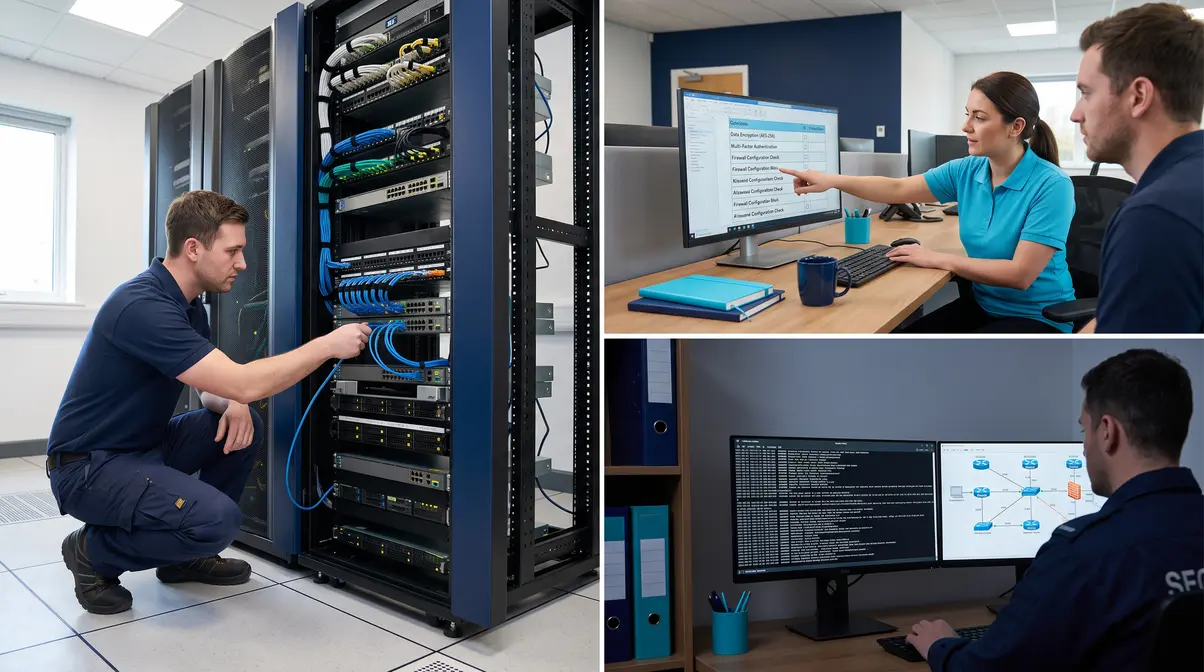
Software-level routing rules and multi-WAN failover algorithms are entirely useless if the physical layer of the network fails. The physical foundation of every resilient security and ICT system rests upon compliant, high-grade structured cabling. We must emphasize unequivocally: even the best network failover protection architecture can collapse if poor wiring is used during installation.
Our engineers strictly utilise certified Cat5E or Cat6 Ethernet cable for every network device deployment. We actively warn commercial clients against the catastrophic risks of cheap, non-certified cable and poor quality connectors. Substandard copper-clad aluminium (CCA) cables introduce high electrical resistance, severe packet loss, and physical brittleness. Over time, CCA cabling oxidises and fails to deliver the required Power over Ethernet (PoE) wattage demanded by high-definition pan-tilt-zoom cameras or illuminated access control readers, leading to intermittent hardware reboots that mimic carrier outages.
Furthermore, deploying physical security within commercial buildings across Perth introduces distinct installation complexities that demand licensed, highly skilled technicians. Leveraging existing infrastructure requires careful assessment; older facilities often feature legacy unshielded cabling, corroded patch panels, or congested conduit paths that cannot support modern high-throughput network devices. Our engineers evaluate every meter of legacy infrastructure before integrating it with modern redundant systems.
Installation complexity varies significantly across architectural environments:
- Exposed Conduit on External Brick: Demands UV-stabilised, heavy-duty rigid PVC or galvanised steel conduit to safeguard Cat5E or Cat6 Ethernet cable from environmental degradation, accidental impact from machinery, and intentional vandalism.
- Concealed Cabling in Wall Cavities: Requires specialized installation tools, cable rods, and fish tapes to navigate structural timbers, insulation, and steel framing within commercial drywall assemblies.
Our professionals know how to avoid damages to the building fabric during every installation. Maintaining fire-stop ratings within riser shafts, sealing exterior building penetrations against moisture ingress, and preserving the acoustic dampening properties of interior walls are core engineering requirements for our installation teams. Physical craftsmanship and digital resilience must go hand in hand.
Commercial Security Hardware and Failover Interactions
When implementing redundant routing, small business managers must understand how specific components within their commercial security suite react to an unexpected carrier disconnection. The table below outlines how standard primary connection drops affect specific hardware classifications, and the direct mitigation provided by automated failover systems.
| Security Asset Type | Network Device? | Impact of Fixed Broadband Outage | Mitigation via Network Failover |
|---|---|---|---|
| Commercial CCTV System | Yes (Communicates via Cat5E/Cat6) | Loss of offsite live monitoring; push alerts fail; offsite cloud archival halts entirely. | Dynamically shifts stream feeds and push notifications to secondary 4G/5G mobile data uplinks. |
| Commercial Access Control | Yes (IP-based controllers) | Inability to revoke cards remotely; audit trails stop syncing; remote gate/door releases blocked. | Maintains real-time database synchronisation with centralized management consoles via redundant cellular WAN. |
| Commercial Intrusion Alarm | No (Dedicated dialler/signalling) | If wired via broadband adaptor, alarm signals fail; traditional cellular diallers remain active. | Allows cross-system verification by keeping associated CCTV network devices online to validate alarm triggers. |
| Fire & Duress Alarms | No (Supervised signalling paths) | Dedicated diallers handle transmission, but onsite building management portals lose remote visibility. | Preserves real-time telecommunication links to ensure emergency service coordinators receive building telemetry. |
As illustrated, integrating network failover protection directly preserves the utility of your most data-intensive network devices. By prioritising critical security packets over general staff web traffic during a secondary WAN activation, our multi-WAN routing rules prevent mobile data congestion, assuring that essential video frames and door event telemetry arrive at their destination without packet drops.

Mitigating Operational Risk Without Inflated Ongoing Costs
In the security industry, unscrupulous providers frequently attempt to market their systems as bulletproof or unbreakable. We explicitly reject this rhetoric. We do not claim 100% security, because no system subject to real-world physical and digital threats can truthfully make that claim. Instead, our professional focus is grounded entirely in rigorous Risk Mitigation and strict compliance with Australian Consumer Law (ACCC compliance).
Every commercial facility operates within a unique risk profile. Evaluating network failover protection purely through the lens of risk mitigation allows small business managers to systematically eliminate high-probability vulnerabilities—such as standard broadband dropouts—without overspending on unnecessary operational complexity. We engineer solutions that deliver tangible operational continuity, preventing common network failures from undermining your physical perimeter defence.
Financial transparency is equally essential. Small business managers are routinely subjected to aggressive, locked-in subscription models that demand exorbitant monthly software fees for basic connectivity features. We approach system architecture differently:
- We prioritize commercial systems engineered with no or minimal ongoing monthly fees, maximizing return on investment for small commercial sites.
- We never bind clients into opaque, multi-tiered subscription bundles for basic on-premise hardware operations.
- Our transparent, non-restrictive pricing model offers tailored installations starting from an upfront base cost, such as entry-level cellular multi-WAN failover integrations starting from $1,250, depending upon building size and existing network topography.
By focusing on robust, commercial-grade hardware that functions independently of proprietary cloud paywalls, we assure that our clients retain full ownership and control over their physical security infrastructure.
The Small Business Manager’s Guide to Implementing Resilient Failover
Transitioning a commercial facility from a fragile, single-connection setup to a resilient dual-WAN topology requires a structured, orderly engineering approach. For small business managers overseeing commercial warehouses, retail showrooms, or professional offices, we recommend taking the following actionable steps:
1. Audit Your Physical and Network Layer
Examine the termination point of your incoming internet service. Are external communications cables exposed to physical tampering or severe weather? Inspect your network rack to ensure your patch panels utilise verified Cat5E or Cat6 Ethernet cable, and verify that your network switches supply adequate PoE+ budgets to keep cameras and access control readers powered during line fluctuations.
2. Map Out True Network Devices
Classify every security component within your commercial building. Group your commercial CCTV cameras and IP access control controllers into dedicated, isolated Virtual Local Area Networks (VLANs). Separate these critical network devices from public Wi-Fi networks, staff workstations, and untrusted IoT equipment. Ensure your commercial alarms are wired into dedicated, monitored cellular pathways rather than sharing open office ports.
3. Architect Intelligent Failover Thresholds
Consult with an integrated provider capable of deploying hardware with automated network failover protection. Ensure the router is programmed to balance data loads intelligently: during a primary WAN failure, non-essential internet activities (such as staff video streaming or non-critical file synchronization) should be throttled or blocked entirely, reserving secondary cellular bandwidth exclusively for commercial security telemetry, VoIP telecommunication, and real-time collaboration tools.
4. Conduct Routine Failure Simulations
A failover plan is merely theoretical until it has been physically tested. Our technical teams conduct live pull-plug testing, physically disconnecting the primary fibre broadband terminal while the commercial site is operating under load. We monitor the automated state shift, measure the latency before the secondary cellular interface assumes the load, and assure that CCTV live feeds and access control management consoles maintain uninterrupted connectivity.
By enforcing this structured methodology, a resilient network failover protection strategy prevents small business managers from facing unexpected system blindness when external utilities suffer unexpected downtime.
Fortifying Perth Facilities with Seamless Continuity
Modern commercial enterprises cannot afford the operational, financial, and legal fallout of blind security systems. As IP-based commercial CCTV and advanced access control platforms continue to take on greater responsibilities within facility management, their reliance on consistent, high-availability data throughput will only accelerate. Leaving these vital network devices reliant upon a solitary, unshielded internet connection represents an unacceptable operational risk.
Smart SYS delivers the technical expertise required to merge robust physical security with advanced digital telecommunication infrastructure. By combining our Dual-Engine model of ICT Services and advanced Security Services under a Single Point of Accountability, we eliminate the friction, finger-pointing, and vulnerabilities that plague disjointed commercial installations. From replacing cheap, non-certified cable and poor quality connectors with precision-tested Cat5E or Cat6 Ethernet cable, to configuring carrier-grade multi-WAN gateways, we tailor every system to meet the rigorous physical demands of Western Australian commercial sites.
Ultimately, adopting multi-WAN network failover protection is no longer an optional luxury for commercial sites; it is a fundamental requirement of proactive risk mitigation. We invite small business managers to partner with our specialized engineering team, assuring that your facility’s operational continuity, staff safety, and physical assets remain uncompromised, no matter what occurs across the broader network grid.
Frequently Asked Questions
What is the difference between how commercial CCTV and alarm panels handle internet dropouts?
Commercial CCTV cameras and access controllers are IP-based network devices that rely on your local broadband connection to transmit live video, synchronise user credentials, and send push alerts. In contrast, commercial alarm panels communicate via dedicated, independent cellular diallers isolated from your local area network (LAN), though online CCTV is still required to visually verify alarm triggers.
How quickly does automated network failover switch over to the secondary connection?
Automated failover gateways continuously check link stability via echo requests and latency metrics. When the primary fixed broadband link fails to respond within set thresholds, the router executes an autonomous state switch within milliseconds to seconds, preserving active data sessions without requiring manual intervention from facility staff.
Will high-bandwidth security cameras exhaust cellular data allowances during an outage?
Properly architected multi-WAN gateways implement dynamic traffic shaping and bandwidth prioritisation. When switched to a secondary 4G or 5G cellular link, non-essential web traffic and background downloads are throttled or blocked, ensuring available mobile data is reserved strictly for critical video alerts, access logs, and business VoIP telecommunications.
Can failover protection be integrated into our existing commercial security infrastructure?
Yes, provided the facility utilises compliant, certified Cat5E or Cat6 Ethernet structured cabling. A technical audit assesses your existing network switches, Power over Ethernet (PoE) budgets, and gateway hardware to integrate a multi-WAN redundant router directly into your current setup without replacing functional IP cameras or door controllers.
Never Let an Outage Compromise Your Security
An unexpected drop in connectivity shouldn’t blind your CCTV or lock down your access controls. Protect your business with enterprise-grade network infrastructure designed for seamless, automated failover and 24/7 uptime.
Post Comment