NVR vs Cloud CCTV: 2026 Perth Commercial Cost Guide

NVR vs Cloud CCTV costs compared for Perth businesses. Analyse 2026 upfront hardware, subscription fees, and data risks to choose the right system.
NVR vs Cloud CCTV comes down to capital expenditure versus ongoing subscription fees: on-premise NVRs eliminate recurring SaaS costs and bandwidth bottlenecks, whereas cloud CCTV provides managed remote accessibility with higher multi-year operating expenses.
📌 Executive Summary & Key Technical Takeaways
- Direct Architecture Comparison: On-premise NVR appliances record high-bitrate video locally across certified Cat5E or Cat6 Ethernet cabling without consuming internet bandwidth, while pure cloud CCTV offloads recording off-site at the expense of continuous uplink saturation and per-camera monthly subscriptions.
- Essential Infrastructure Standard: High-quality commercial CCTV systems provide clear, evidentiary-grade footage that supports accurate incident verification and liability protection, which requires robust physical infrastructure and managed network switches to prevent frame dropping.
- Dual-Engine Accountability: Our Dual-Engine model integrates physical electronic security with enterprise ICT infrastructure, acting as your single point of accountability to resolve network bottlenecks and eliminate contractor blame games.
- Commercial Recommendation: For small business managers and commercial facility operators across Perth, a hybrid deployment—pairing local NVR retention with automated, encrypted cloud event replication—delivers maximum disaster resilience while keeping multi-year operating expenditures under control.
Selecting the optimal video surveillance architecture is one of the most consequential decisions facing small business managers and commercial facility operators across Perth. The balance between physical Network Video Recorders (NVRs) and modern cloud-hosted repositories dictates not only your capital investment and multi-year operational budgets, but also your site’s physical security resilience, cyber risk profile, and regulatory compliance. As high-definition IP camera adoption accelerates across Western Australia, understanding the underlying network transmission realities and storage dynamics is crucial. This technical and cost guide examines the real-world performance, bandwidth limitations, and 5-year financial trade-offs between NVR and cloud CCTV deployments.
Table of Contents:
- What is an On-Premise Network Video Recorder (NVR)?
- Understanding Cloud CCTV Storage & Cloud NVR Architecture
- HDD vs Cloud Storage for CCTV: Drive Reliability vs Virtual Repositories
- How Much Does Commercial CCTV Cloud Storage Cost in Australia?
- 2026 Commercial CCTV Cost Breakdown: NVR vs Cloud Storage
- CCTV Cloud Storage Australia: Data Sovereignty and Bandwidth Realities
- How Long Will 1TB Last on CCTV? Commercial Calculation Guide
- The Hybrid Dual-Engine Architecture: Best of Both Worlds
- The Role of Certified Structured Cabling and Building Protection
- Which Storage is Best for Commercial CCTV? Decision Matrix
What is an On-Premise Network Video Recorder (NVR)?
A Network Video Recorder (NVR) is a specialised computing appliance engineered to ingest, decode, manage, and record digital video streams transmitted across a local area network (LAN) from IP cameras. Unlike legacy analogue DVR systems that digitise baseband video over coaxial runs, an NVR interfaces with IP cameras that compress and encode video directly at the sensor level.
In commercial facilities throughout Perth, the NVR is installed within a locked communications rack or secure server room. Because it connects directly through Power-over-Ethernet (PoE) network switches over certified Cat5E or Cat6 Ethernet cable, it operates continuously and independently of external internet connectivity for all local recording operations.
How NVR Storage Solutions Operate in Commercial Environments
Commercial NVR hardware relies on dedicated surveillance-grade mechanical hard disk drives engineered for continuous 24/7 write duty cycles under demanding thermal conditions. The NVR manages drive striping, automated overwrite schedules, RAID configurations for disk redundancy, and embedded Video Management Software (VMS). By isolating recording traffic to dedicated security Virtual Local Area Networks (VLANs), our technicians ensure that high-resolution video streams never degrade day-to-day office computing or corporate telecommunications.
Remote access is achieved through authenticated, encrypted WAN tunnels or VPN connections, allowing authorised managers to review evidentiary records without streaming high-bandwidth footage around the clock to third-party offshore cloud servers.
Advantages and Limitations of On-Premise NVR Storage
Evaluating an NVR deployment requires assessing capital expenditure against operational performance. Key advantages include:
- Fiscal Predictability: Once installed, an on-premise NVR carries minimal ongoing monthly fees, protecting your operating budget over a 5-to-7-year hardware lifecycle.
- Total Independence from External Telco Outages: If your local commercial broadband experiences an unexpected drop, the NVR continues archiving high-bitrate footage across all channels without losing a single frame.
- Evidentiary-Grade Throughput: High-quality commercial CCTV systems provide clear, evidentiary-grade footage that supports accurate incident verification and liability protection, running at full sensor resolution and frame rate (25–30 fps) across local gigabit backbones.
- Complete Data Sovereignty: Video files never leave your physical premises unless explicitly exported, ensuring strict compliance with Australian internal governance policies.
The primary architectural vulnerability of a standalone NVR is physical: if a catastrophic event occurs, such as a localized fire, water damage, or targeted physical theft of the recording unit during a break-in, the unbacked-up video archive could be lost.
Understanding Cloud CCTV Storage & Cloud NVR Architecture
Cloud CCTV relocates the primary storage and management repository to distributed hyperscale data centres. IP cameras encode video and transmit compressed streams across your commercial internet gateway directly to cloud servers using TLS/AES-256 encryption.
A cloud-native Video Management System centralises multi-facility oversight onto a single web pane. This architecture appeals to multi-site operators seeking unified remote access across disparate geographic sites without maintaining dedicated local servers at each address.

Cloud NVR for IP Cameras vs Local Appliance Systems
Deploying a cloud NVR framework changes how security data interacts with your core network infrastructure. While local NVR setups confine video traffic to private LANs, pure cloud systems require constant outbound internet streams. The market typically utilises two main delivery models:
- Direct-to-Cloud Cameras: Edge-compute IP cameras that stream compressed video directly through an internet gateway to cloud repositories without any intermediary appliance on-site.
- Cloud Gateway/Bridge Deployments: A compact on-site edge bridge that buffers local camera streams, applies compression and encryption, and manages outbound transmission to the cloud platform.
Operational Constraints of Pure Cloud CCTV for WA Enterprises
While cloud surveillance eliminates physical recorder maintenance, commercial facility managers must navigate several practical drawbacks:
- Broadband Upload Bottlenecks: Streaming multiple high-definition IP camera feeds off-site requires substantial upload capacity. Standard commercial NBN connections can easily become congested, causing jitter and latency across business VoIP lines and enterprise software.
- Compounding SaaS Licensing: Cloud storage is billed as a continuous per-channel recurring subscription. Across 16 to 32 cameras, ongoing subscription fees accumulate rapidly, driving multi-year expenditure substantially higher than on-premise hardware.
- Vulnerability to Broadband Disruptions: If external telecommunications drop, direct-to-cloud cameras cannot reach remote servers, creating blind spots during the outage unless costly onboard SD card edge buffering is equipped.
- Enforced Video Compression: To mitigate severe cloud storage overhead and network saturation, cloud providers frequently throttle video frame rates down to 8–12 fps and apply aggressive compression, which can compromise forensic detail during police investigations.
- Jurisdictional Custodianship Risks: Off-site archives stored with international providers introduce data jurisdiction questions regarding access controls and compliance with the Australian Privacy Principles.
HDD vs Cloud Storage for CCTV: Drive Reliability vs Virtual Repositories
When assessing hdd vs cloud storage for cctv, small business managers must understand the physical and virtual characteristics of each medium. Surveillance-rated hard disk drives (such as Western Digital Purple or Seagate SkyHawk) are not standard desktop drives; they are mechanically tuned to operate under continuous 24/7/365 write cycles with specialised firmware that prioritises uninterrupted write streaming over read verification.
| Evaluation Parameter | Surveillance Hard Disk Drives (NVR / RAID) | Cloud Virtual Storage Repositories |
|---|---|---|
| Bandwidth Reliance | Zero external bandwidth. Direct write across local LAN switches. | Heavy, continuous reliance on commercial uplink connection. |
| Hardware Lifespan & MTBF | Typically 3 to 5 years under continuous write workloads. | Abstracted by cloud vendor; automatic hardware replacement. |
| Write Throughput & Bitrate | High sustained bitrates supporting evidentiary-grade capture. | Frequently throttled or motion-gated to conserve ingest bandwidth. |
| Disaster Resilience | Vulnerable to physical theft or on-premise fire/water hazards. | Resilient against physical on-site damage via off-site redundancy. |
| Long-Term Cost Model | One-off drive procurement starting from $180 AUD per 4TB drive. | Perpetual per-channel subscription fees payable annually. |
Surveillance HDDs configured in RAID arrays (such as RAID 5 or RAID 6) assure fault tolerance against individual mechanical drive failures. Conversely, cloud virtual storage shifts the burden of physical hardware maintenance to enterprise data centres, providing off-site disaster redundancy at the cost of continuous internet dependency and recurring monthly licensing.
How Much Does Commercial CCTV Cloud Storage Cost in Australia?
Small business operators frequently ask: How much does CCTV cloud storage actually cost in Australia? Unlike residential subscription models, commercial cloud video storage pricing depends on camera resolution, required retention days (such as standard 30-day compliance windows), frame rate guarantees, and artificial intelligence metadata tiers.
In the Australian commercial security market, professional cloud CCTV services generally conform to the following pricing tiers:
- 30-Day Event-Only Cloud Storage: Starting from $15 to $25 AUD per camera, per month. Cameras only upload footage upon detecting motion or line-crossing triggers, conserving bandwidth while delivering basic off-site incident backup.
- 30-Day Continuous (24/7) Standard-Resolution Cloud Storage: Starting from $30 to $50 AUD per camera, per month. Footage is streamed continuously at throttled frame rates (typically 10–15 fps) to Australian cloud instances.
- 30-Day Continuous High-Bitrate Evidentiary Cloud Storage: Starting from $55 to $85 AUD per camera, per month. Designed for high-security perimeters requiring evidentiary-grade frame rates and advanced cloud analytics.
For an 8-camera commercial deployment requiring 30 days of standard continuous retention, cloud licensing alone amounts to approximately $2,880 to $4,800 AUD per year in operational expenditure. Over a standard 5-year lifecycle, software subscriptions can total over $14,000 AUD—excluding initial camera hardware and certified network cabling installation costs.
2026 Commercial CCTV Cost Breakdown: NVR vs Cloud Storage
Evaluating an investment in commercial electronic security requires analysing the 5-year Total Cost of Ownership (TCO). While cloud systems may lower upfront hardware outlays slightly by eliminating the NVR chassis, their recurring operational overhead substantially increases overall expenditure over time.
| Cost Parameter | Commercial NVR System (8 Cameras) | Pure Cloud CCTV System (8 Cameras) | Smart SYS Hybrid Dual-Engine (8 Cameras) |
|---|---|---|---|
| Initial Hardware & Installation | Starting from $3,400 AUD | Starting from $2,800 AUD | Starting from $3,950 AUD |
| Annual SaaS / Cloud Storage Fee | $0 AUD (Minimal ongoing fees) | $2,400 – $4,000 AUD / year | $400 – $750 AUD / year (Event Backup) |
| Bandwidth Upgrade Overhead | Nil (Local switching) | High (Requires dedicated symmetrical uplink) | Low (Burst event uploads only) |
| 5-Year Total Cost of Ownership | From $3,400 AUD | From $14,800 AUD | From $5,950 AUD |
| Operation During Telco Outage | 100% Uninterrupted Local Archiving | Recording stops without edge SD buffer | 100% Local Archiving (Syncs on reconnect) |
For a complete engineering breakdown of pricing structures across Western Australia, consult our comprehensive resource on Perth Commercial CCTV Costs 2026: Why an Audit is Key and review our guide on Commercial Security System Pricing: 2026 Perth Cost Guide.
CCTV Cloud Storage Australia: Data Sovereignty and Bandwidth Realities
Deploying cloud surveillance in Australia involves evaluating both regulatory compliance and telecommunication constraints. Commercial footage capturing employees, contractors, and client interactions must be handled in alignment with the Australian Privacy Principles (APPs).
Related Commercial Analysis:
Perth Commercial CCTV Costs 2026: Why an Audit is Key
WA Regulatory Standards and Data Sovereignty
When selecting a cloud CCTV provider, verify the exact geographical location of the host data centres. Offshore cloud platforms in overseas jurisdictions can expose your enterprise to legal discovery complications and privacy compliance risks. We advise our commercial clients to mandate sovereign Australian hosting—such as AWS Sydney/Melbourne or Microsoft Azure Central—to assure local legal jurisdiction, lower network round-trip latency, and simplify regulatory adherence.
NBN Uplink Constraints Across Perth Industrial Zones
Commercial estates across Perth (including Welshpool, Kewdale, Malaga, Canning Vale, and Osborne Park) often rely on asymmetric NBN connections. While download bandwidth might comfortably reach 250 to 500 Mbps, upload bandwidth is frequently restricted to 40 or 50 Mbps on standard business profiles.
A single commercial IP camera streaming evidentiary-grade video requires between 4 Mbps and 8 Mbps of continuous upload capacity. An array of 10 to 12 cameras transmitting 24/7 directly to a cloud repository will completely exhaust a 50 Mbps upload ceiling. This saturation causes packet loss, dropped security frames, voice distortion on corporate VoIP systems, and noticeable latency across core cloud software applications.
How Long Will 1TB Last on CCTV? Commercial Calculation Guide
Determining retention capacity is an essential step during surveillance engineering. How long 1TB of storage lasts on a commercial CCTV system depends on compression codecs, camera bitrates, frame rates, and recording schedules.
Codecs and Compression Efficiency: H.265 vs H.264
Modern commercial CCTV installations engineered by Smart SYS utilise H.265 (High-Efficiency Video Coding) or smart surveillance codecs. H.265 reduces storage requirements by roughly 40% to 50% compared to legacy H.264 without sacrificing image quality, allowing longer video retention on smaller capacity drives.
Estimated retention for 1TB of storage running a single commercial IP camera stream at 15 fps:
- H.264 Continuous 24/7 Mode: 1TB provides approximately 10 to 14 days of video.
- H.265 Continuous 24/7 Mode: 1TB provides approximately 22 to 30 days of video.
- H.265 Smart Motion Detection Mode: In typical business environments with 8–10 active hours per day, 1TB provides approximately 60 to 90 days of retention.
Sizing Storage for Multi-Camera Commercial Deployments
Storage requirements scale directly with camera numbers. For a commercial site running 8 IP cameras requiring 30 days of continuous evidentiary-grade retention, the total required storage is calculated as follows:
8 Cameras × 30 Days × H.265 Bitrate (approx. 4GB/hour/camera) ≈ 8TB to 12TB of RAW storage capacity.
With an on-premise NVR, configuring 12TB of dedicated surveillance storage using enterprise-grade hard drives is straightforward and economical. In a pure cloud setup, storing 12TB of continuous video requires premium per-channel subscription tiers that accumulate year after year.
The Hybrid Dual-Engine Architecture: Best of Both Worlds
Commercial enterprises do not need to choose between the cost-containment of an NVR and the off-site protection of the cloud. The most robust operational strategy for Perth commercial facilities is a Hybrid CCTV Architecture.

Related Commercial Analysis:
Commercial Security System Pricing: 2026 Perth Cost Guide
How Hybrid CCTV Engineering Operates
In a hybrid configuration deployed by Smart SYS:
- Continuous Local Archiving: The on-premise NVR captures continuous 24/7 evidentiary-grade video across all cameras at high frame rates over local LAN switches. Bandwidth is contained locally, and recording remains uninterrupted during internet outages.
- Intelligent Cloud Offloading: Rather than streaming massive uncompressed continuous video off-site, smart edge analytics identify high-priority security triggers (such as perimeter breaches, forced doors, or after-hours movement in server rooms) and replicate encrypted event clips and high-resolution stills immediately to the cloud.
- Disaster Resilience: If an intruder tampers with or destroys the local NVR hardware, the critical breach footage is already secured off-site in the cloud repository, preserving essential evidence for police and insurer investigations.
The Smart SYS Dual-Engine Model: Single Point of Accountability
Deploying a resilient surveillance architecture requires convergence between two disciplines: Physical Commercial Security and Enterprise ICT Infrastructure.
Traditional installations frequently lead to vendor conflict: security contractors blame internal network equipment for dropped video feeds, while IT teams accuse security technicians of exposing corporate subnets to bandwidth congestion and unmanaged hardware vulnerabilities. At Smart SYS, our Dual-Engine Model addresses both domains directly:
- End-to-End Technical Ownership: We design, deploy, and manage the physical security layer (commercial IP cameras, NVRs, commercial access control) as well as the underlying network layer (managed PoE switches, VLAN segmentation, QoS traffic management, and telecommunications routing).
- Network Quality of Service: We configure advanced Quality of Service (QoS) rules that prioritise operational voice and data traffic, assuring that surveillance video streams never disrupt business-critical VoIP or enterprise cloud systems.
Note: Under Australian industry standards, commercial CCTV and Access Control platforms operate as network-connected IP systems, whereas commercial intruder alarm systems function as independent electronic panels with dedicated signalling channels.
The Role of Certified Structured Cabling and Building Protection
A video surveillance system is only as reliable as the structured cabling that powers and connects it. Substandard wiring leads to intermittent packet loss, camera drops, and premature hardware failure.
Certified Cat5E / Cat6 Cabling vs Copper-Clad Aluminium (CCA)
Our licensed technicians install only Australian-certified, solid-copper Cat5E or Cat6 Ethernet cable. Budget providers sometimes cut corners with Copper-Clad Aluminium (CCA) wiring, which causes excessive voltage drops over extended PoE distances, generates excess heat, and is prone to brittle fractures. Certified Cat6 solid copper ensures reliable power delivery, gigabit network throughput, and signal integrity over the operational life of your system.
Infrastructure Assessment and Preserving Building Integrity
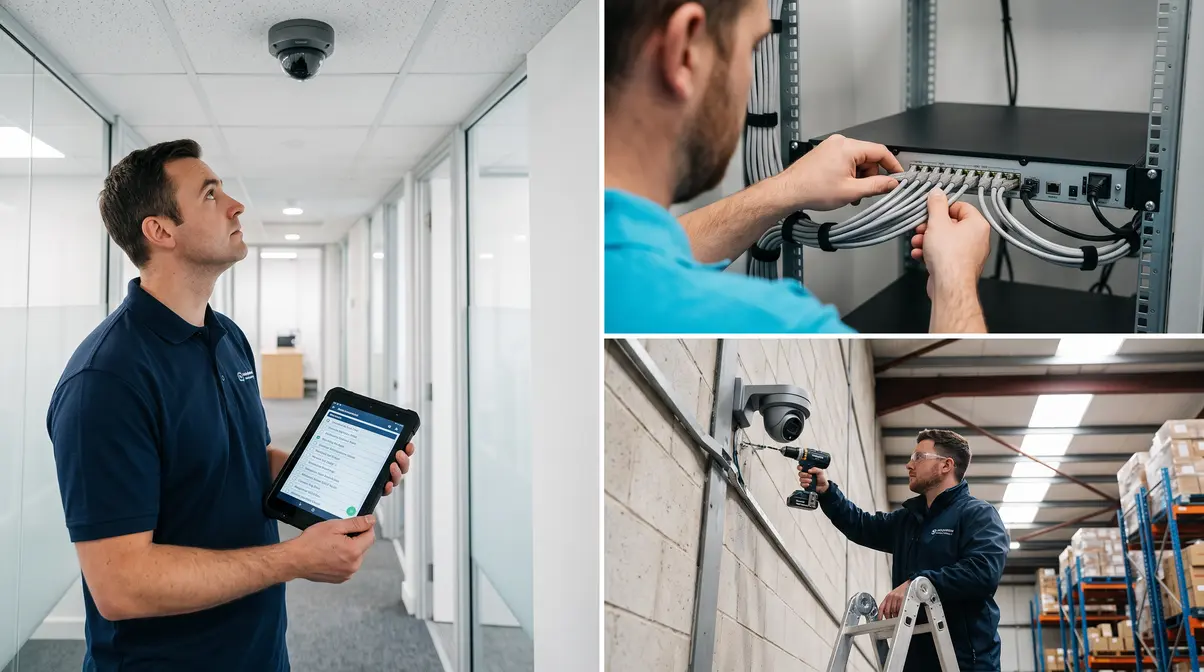
Deploying commercial electronic security requires careful planning around building fabric preservation. Our qualified technicians conduct detailed infrastructure assessments to evaluate existing cable risers, ceiling pathways, and containment infrastructure. Whether installing concealed cabling inside corporate drywall cavities or running heavy-duty rigid conduit across exposed masonry in industrial Perth warehouses, we manage installation complexity carefully to avoid structural damage and maintain professional commercial aesthetics.
Which Storage is Best for Commercial CCTV? Decision Matrix
To determine whether an on-premise NVR, pure cloud surveillance, or a hybrid dual-engine setup is best suited to your operational requirements, use this commercial evaluation matrix:
| Commercial Operational Profile | Recommended Architecture | Engineering Justification |
|---|---|---|
| High Camera Count Commercial Site (16+ Channels) | On-Premise NVR or Hybrid | Eliminates corporate WAN upload saturation and avoids escalating recurring per-camera SaaS subscription fees. |
| Distributed Multi-Site Retail (1–3 Cameras per Branch) | Pure Cloud CCTV VMS | Centralises remote visibility across multiple regional branches without requiring on-site recording servers at each footprint. |
| High-Risk Commercial, Logistics & Industrial Facilities | Smart SYS Hybrid Dual-Engine | Provides continuous 24/7 evidentiary-grade local recording alongside off-site cloud replication for alarms, assuring complete incident preservation. |
| Variable NBN or Asymmetric Internet Profiles | On-Premise NVR | Isolates security video streaming to internal switches, ensuring recording integrity is completely protected from internet drops. |
Frequently Asked Questions
How does the total cost of ownership compare between an on-premise NVR and cloud CCTV in Australia?
While cloud CCTV often features lower upfront equipment costs, ongoing per-camera subscriptions (starting from $30 to $50 AUD monthly for continuous recording) substantially inflate multi-year operating expenditure. On-premise NVRs require higher initial capital for hardware and certified cabling installation, but eliminate recurring SaaS fees, offering significantly lower five-year total costs for commercial sites.
Will a commercial CCTV system continue recording if the internet goes down?
An on-premise NVR records directly across local Ethernet cabling and internal network switches, continuing uninterrupted 24/7 recording regardless of external broadband outages. Pure direct-to-cloud cameras rely on continuous internet connectivity to transmit video off-site, meaning recording will pause during an outage unless the cameras are equipped with local edge buffering such as internal SD cards.
How many days of commercial CCTV footage can 1TB of storage hold?
Storage duration depends on the video codec, frame rate, and recording schedule. With modern H.265 compression running at 15 fps, 1TB typically stores around 22 to 30 days of continuous 24/7 video for a single IP camera. In smart motion-activated recording modes within typical commercial operating hours, 1TB can extend retention to between 60 and 90 days.
Why is a hybrid CCTV architecture recommended for Perth commercial facilities?
A hybrid model captures continuous, evidentiary-grade footage locally on an on-premise NVR without saturating business internet upload speeds, while replicating encrypted event clips to secure cloud servers. This ensures off-site redundancy if the local recorder is damaged or stolen during an incident, whilst avoiding the high multi-year subscription costs of continuous pure cloud storage.
Deciding Between On-Prem NVR and Cloud CCTV for Your Perth Facility?
Book an on-site commercial consultation with our dual-licensed ICT and security engineers to evaluate network bandwidth, compliance, and accurate 5-year TCO.


1 comment