IT Disaster Recovery Perth: 2026 Business Continuity Guide
IT disaster recovery Perth solutions to safeguard critical commercial data and business continuity. Explore Smart SYS’s 2026 enterprise blueprint.
Reliable IT disaster recovery in Perth integrates resilient data replication, local-to-cloud failover, and physical facility protection to restore commercial ICT operations swiftly following power loss, hardware destruction, or cyber events. For small business managers and commercial facility operators across Western Australia, achieving true business continuity demands more than off-the-shelf software backups—it requires an architectural defence spanning digital assets and physical infrastructure.
📌 Executive Summary & Key Technical Takeaways
- IT Disaster Recovery Perth Standards: True resilience pairs immediate on-site restoration capability with geo-redundant Australian cloud storage to counter WA’s interstate latency and local environmental risks.
- Critical Physical Layer: System availability relies on certified Cat5E or Cat6 Ethernet cable, secure comms rooms, and commercial access control rather than uncertified patch leads that create catastrophic points of failure.
- Dual-Engine Model: Managing ICT services alongside commercial electronic security under Smart SYS eliminates vendor finger-pointing during unexpected outages.
- Governance & Compliance: Clear Recovery Time Objectives (RTO) and Recovery Point Objectives (RPO) assure alignment with ACCC operational guidelines and Australian data protection mandates.
Rethinking Resilience: A Blueprint for Perth Businesses Disaster Recovery in 2026
For small business managers and commercial facility operators in Western Australia, the conversation around operational resilience is often dominated by distant threats—cyberattacks originating from overseas or global supply chain disruptions. Yet, the most significant risks can be much closer to home. A severe summer power outage, a burst water pipe in the ceiling, or a break-in can cripple operations just as effectively as a sophisticated ransomware attack. The traditional approach to business continuity is no longer sufficient. It’s time for a forward-thinking strategy, a 2026 blueprint for IT disaster recovery in Perth that integrates every facet of your commercial operations.
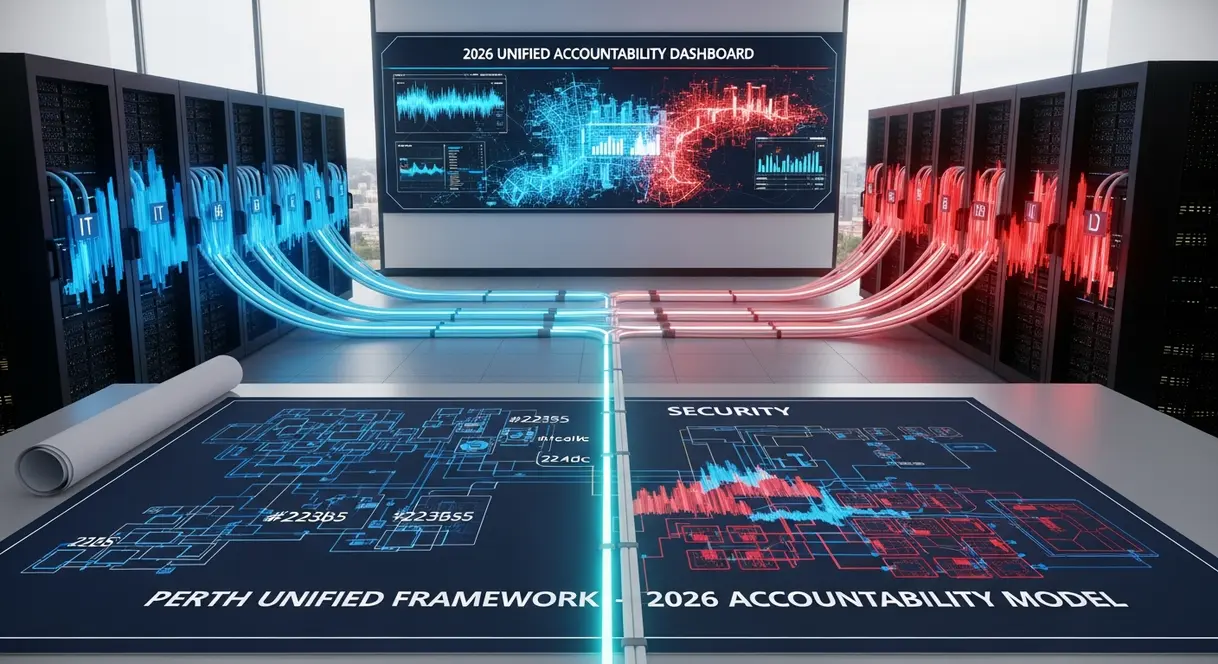
At Smart SYS, we’ve seen the fallout when fragmented systems fail. An IT provider blames the security contractor for a physical breach that led to data theft; the security installer points to network failures. This “blame game” leaves you, the business manager, caught in the middle with your operations at a standstill. Our approach is fundamentally different. As Perth’s leading Integrated ICT & Security agency, we operate on a Dual-Engine model, combining our expertise in both ICT Services and physical Security Services. This makes us your Single Point of Accountability, assuring a cohesive and comprehensive strategy for true operational resilience without finger-pointing.
What Is a DRP Document? Backup vs. Disaster Recovery Explained
A common vulnerability we observe across Western Australian enterprises is confusing basic data backup with a functional Disaster Recovery Plan (DRP). While standard backups copy raw files to a hard drive or cloud repository, they do not provide an operational pathway to restore your workflow when hardware fails or infrastructure is destroyed.
To establish resilient compliance with Australian data protection standards, managers must recognise how these elements differ:
- Data Backup and Recovery: The tactical process of copying digital files and databases. If an employee accidentally overwrites a spreadsheet, backup recovery restores that single file. However, if your comms room floods, having raw backup files without functioning server hardware or network switching will leave your workforce idle for days.
- IT Disaster Recovery (DR): The systematic restoration of the entire technology stack—servers, virtual machines, telecommunications, VoIP routing, and commercial database environments. DR provides the exact computing resources and network switches required to run business-critical applications when primary systems collapse.
- What is a DRP Document? A Disaster Recovery Plan (DRP) is a formal, documented operational manual that defines step-by-step procedures for technical teams during an unexpected crisis. Aligned with structured frameworks such as the NIST SP 800-34 Contingency Planning standard, a comprehensive DRP outlines immediate incident response roles, communication trees, alternate operating sites, prioritized application restoration sequences, and detailed operational recovery runbooks.
Beyond the Firewall: The Physical Dimension of Data Disasters
When most managers think of disaster recovery, their minds jump to digital threats like malware, phishing, and server crashes. While these are critical concerns, this narrow view overlooks a massive area of vulnerability: the physical environment. A robust Disaster Recovery plan must acknowledge that a physical security event is almost always a data and ICT event.
Consider these scenarios:
- Theft: An intruder breaks in and steals servers, workstations, and network hardware. This isn’t just a loss of physical assets; it’s a catastrophic data loss event, especially if backups are stored on-site and are also stolen.
- Vandalism: Malicious damage to your communications room can sever network connectivity, destroy backup devices, and take your entire operation offline for days.
- Environmental Damage: A fire, even a small one, can destroy critical infrastructure. Water from a burst pipe or firefighting efforts can be equally devastating to electronic equipment.
Our integrated approach directly addresses this blind spot. We architect solutions where your physical security systems are not just passive deterrents but active components of your recovery strategy. For instance, Commercial Access Control systems are network devices that do more than just lock doors; they create a digital audit trail, logging who entered a sensitive comms space and when, which is invaluable information during a post-incident investigation. Likewise, our high-quality commercial CCTV systems provide clear, evidentiary-grade footage that supports accurate incident verification and liability protection, helping to determine the precise cause and scope of a physical event that impacts your data.
It’s crucial to understand the technical distinctions. While Commercial CCTV and Access Control systems are integral network devices, other systems like Duress or Fire Alarms are not. Our professionals are experts in designing and installing these disparate systems so they work in concert to form a layered defence for your commercial premises and the critical data within.


The Core Components of a Modern Disaster Recovery Plan
Building a resilient operation for 2026 and beyond requires moving beyond simple file backups. A truly effective strategy is a multi-layered ecosystem designed to keep your commercial operations running, no matter the disruption. As architects of these systems, we build every plan around a few non-negotiable pillars.
Data Backup, Replication, and an Unbreakable Chain of Custody
The foundation of any Disaster Recovery strategy is, without question, your data. We advocate for the industry-standard 3-2-1 rule as a baseline:
- Three copies of your critical business data.
- Stored on two different types of media (such as an on-premise Network Attached Storage array and a dedicated cloud repository).
- With at least one copy stored off-site and logically air-gapped or immutable against ransomware tampering.
The “off-site” component is particularly vital in the Perth context. A single event like a localised commercial fire or storm surge could wipe out both your primary equipment and your local backups. We design hybrid configurations leveraging sovereign Australian cloud data centres, delivering geographical redundancy that safeguards you from localized disasters. However, simply storing backups is never enough. Backups must undergo regular, automated verification to assure data integrity. An unverified backup offers false comfort and remains an active business vulnerability.
Defining Your Tolerance for Downtime: RTO & RPO
Two of the most critical metrics in any service-level agreement are the Recovery Time Objective (RTO) and the Recovery Point Objective (RPO). Understanding these is essential for any small business manager:
- Recovery Time Objective (RTO): This is the maximum acceptable length of time your systems can remain offline following an outage. An RTO of 4 hours mandates full restoration of primary workflows within that timeframe.
- Recovery Point Objective (RPO): This dictates the maximum volume of transactional data your operations can afford to lose, measured in time. An RPO of 1 hour ensures you lose no more than the preceding 60 minutes of business records.
These metrics determine your system architecture and capital expenditure. Operating near-zero RTO and RPO benchmarks requires real-time data replication across resilient pathways, while businesses tolerating daily cycles can utilise periodic snapshots. Reviewing these thresholds highlights an essential question: Is Your IT SLA Fit for Purpose? If your existing provider agreement omits clear RTO and RPO commitments, your business is operating without a verified disaster recovery plan.
The ICT Backbone: More Than Just Internet
Your ability to recover depends entirely on the resilience of your underlying network infrastructure. Our ICT Services are designed to be the robust foundation of your entire operation. For Smart SYS, ICT encompasses your complete communications and collaboration ecosystem: Telecommunication links, resilient VoIP phone systems engineered to automatically redirect incoming trunk lines to staff mobiles during an outage, unified communications, and robust switching equipment.
This stability begins at the physical cabling layer. We insist on installing high-performance, certified Cat5E or Cat6 Ethernet cable. Non-certified cabling and low-grade terminations frequently degrade network throughput and become immediate failure points when re-establishing operational switches during emergency system restores.

Related Commercial Analysis:
IT Downtime Costs: A 2026 Warning for Perth Logistics & Retail
What to Look for in a Business Continuity and Disaster Recovery Provider in Western Australia
Selecting a partner to safeguard your enterprise requires evaluating specific technical competencies rather than relying on standard marketing claims. When assessing providers for business continuity in Perth, small business managers and commercial facility operators should insist on the following criteria:
- Sovereign Australian Data Hosting: Verify that off-site replication targets reside in secure Australian-based data centres compliant with Australian privacy laws, rather than unvetted offshore platforms subject to international jurisdictional risks.
- Certified Structured Cabling Capabilities: A provider must understand physical layer integrity. Technicians must be experienced with Cat5E or Cat6 Ethernet cable standards, ensuring that data pathways, comms cabinet patching, and switch links withstand peak operational recovery loads.
- Integrated Dual-Engine Competency: Avoid the vulnerabilities of bifurcated support where an IT firm handles data while an unaligned security contractor oversees the server room doors. Your provider should deliver end-to-end management spanning commercial access control, commercial CCTV, and network infrastructure under a Single Point of Accountability.
- Transparent Operational Costs: Look for service models that eliminate bloated recurring licensing overheads. At Smart SYS, we structure commercial security and ICT implementations starting from predictable baseline figures, emphasising minimal ongoing fees and transparent operational investments.
- Pragmatic Risk Mitigation Over False Promises: Disregard any provider promising 100% security uptime. Legitimate industry leaders focus on realistic risk mitigation, active threat containment, and strict compliance with Australian Consumer Law and ACCC guidelines for business availability.
Building Your 2026 Blueprint: A Practical Guide for Small Business Managers
Developing a comprehensive strategy can feel daunting. We simplify the process by breaking it down into a logical, manageable workflow, guiding our clients from initial assessment to final implementation and testing.
Step 1: The Integrated Risk Assessment
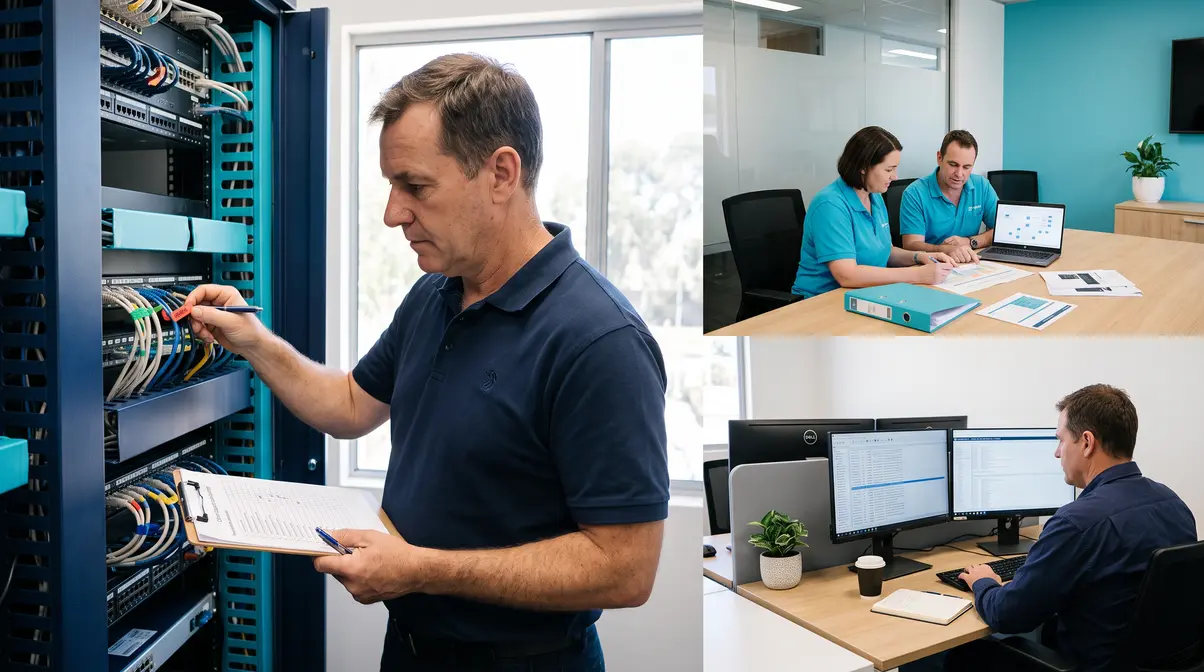
The first step is a holistic evaluation of your unique vulnerabilities. We don’t just look at your servers; we walk your premises. We assess physical security, potential environmental hazards, the state of your existing network cabling, and your current data management practices. This dual-lens (ICT and Security) assessment allows us to identify risks that specialised providers would miss, forming the bedrock of a truly effective Disaster Recovery plan.
Step 2: Architecting the Right Solution (The Smart SYS Advantage)
With a clear understanding of the risks, we architect a tailored solution. This is where our Single Point of Accountability model provides immense value. Because we manage both the ICT and Security engines, there are no operational gaps. The access control system that protects your server room is specified and installed by a team that understands the network switches it connects to. Commercial CCTV cameras are placed not just for general site surveillance, but with a deliberate view to monitoring access to critical ICT racks.
Installation craftsmanship is critical. Our professional technicians understand the intricacies of commercial facilities. Whether running protective conduit along industrial masonry or navigating complex structural cavities, our team installs infrastructure meticulously while avoiding building damage. We assess existing infrastructure thoroughly before expanding upon it, preventing unexpected hardware bottlenecks during stressful operational switchovers.
Step 3: Documentation and Testing – The Path to Assurance
A recovery plan that only exists as an unread manual is ineffective when an emergency strikes. Smart SYS supplies concise, actionable operational documentation outlining step-by-step restoration sequences. Furthermore, we execute controlled recovery drills. These simulations validate our protocols, instruct your team on failover actions, and uncover hidden bottlenecks well before an authentic outage occurs.
For Western Australian commercial operators, documenting continuity systems satisfies essential governance standards. To understand broader national recommendations, review official federal resources on how to create a business continuity plan. Smart SYS translates those high-level directives into functional, site-specific engineering that protects your company’s operational viability.
Why a Generic Solution Fails: The Perth Context for Disaster Recovery
Generic IT templates distributed by providers based on the east coast regularly miss the realities of operating an enterprise in Western Australia. A framework designed for an inner-city Melbourne office rarely withstands the environmental and geographical conditions of the WA commercial sector.
Perth’s geographic isolation creates round-trip network latency to eastern state data hubs. When an organisation attempts to pull terabytes of encrypted images across interstate links during an emergency restore, local network congestion can blow acceptable recovery windows completely out of scope. This is why we deploy hybrid architectures: leveraging high-speed local storage arrays for near-instant restoration alongside geo-redundant cloud archives. This layout assures WA commercial operators speed and geographic resilience simultaneously.
Furthermore, our regional climate creates acute physical hazards. Perth’s extreme summer heat waves place immense strain on server room HVAC equipment, increasing thermal server shutdowns. Suburban commercial parks frequently face summer bushfire alerts, severe storms, and localized grid brownouts. An effective IT business continuity plan in Perth accounts for these local conditions, integrating uninterruptible power supplies (UPS), structured cable management, and climate-controlled comms protection.
The Financial Case for a Robust Disaster Recovery Investment
Commercial decision-makers frequently scrutinize disaster recovery as an overhead expense. However, evaluating the actual financial exposure reveals that failing to prepare is substantially more expensive. When assessing your operational risk, examine the quantifiable costs of business downtime for Perth commercial sectors. If critical transactional databases go dark, what is the per-hour financial deficit? What are the expenses of maintaining idle staff, missing delivery SLAs, and sustaining customer attrition?
Smart SYS delivers sustainable commercial ICT architectures designed with minimal ongoing monthly fees, ensuring transparency and clarity over your total cost of ownership. We steer clear of reckless claims of 100% security, aligning instead with measurable risk mitigation and responsible adherence to ACCC service guidelines. Investing in a resilient IT continuity plan is an operational hedge that protects your bottom line, customer trust, and long-term brand equity.
Partnering with Smart SYS: Your Single Point of Accountability for 2026 and Beyond
The operational threat landscape across Western Australia continues to intensify. By 2026, the enterprises that maintain continuity will be those that have converged their ICT systems and physical security under an integrated resilience model. Standalone cloud backups without a tested infrastructure recovery process leave your commercial facilities vulnerable.
At Smart SYS, our Dual-Engine model bridges the divide between ICT Services and physical Security Services. We remove the operational vulnerabilities of dealing with disparate contractors, delivering cohesive architecture, unified network support, and a single responsive partner when emergency response matters most. We invite small business managers and commercial facility operators across Western Australia to contact our team and develop a resilient, future-ready business continuity and disaster recovery blueprint.
Frequently Asked Questions
What is the difference between standard data backup and an IT disaster recovery plan?
Data backup is the tactical process of copying raw files and databases to secondary storage, which allows the restoration of individual files. In contrast, IT disaster recovery (DR) systematically restores the entire technology environment—including servers, virtual machines, telecommunications, and network switching—guided by a Disaster Recovery Plan (DRP) to resume full commercial operations after major disruption.
Why is a hybrid disaster recovery model recommended for Perth enterprises?
Perth’s geographic distance from eastern state data hubs introduces network latency that can delay restoring terabytes of data across interstate connections. A hybrid model pairs high-speed local storage arrays for rapid, on-premise restoration with geo-redundant Australian cloud repositories, simultaneously addressing local infrastructure risks like summer heat stress and power grid stability.
How do Recovery Time Objectives (RTO) and Recovery Point Objectives (RPO) determine operational planning?
Recovery Time Objective (RTO) defines the maximum acceptable timeframe your business can remain offline following an outage, while Recovery Point Objective (RPO) dictates the acceptable threshold of transactional data loss measured in time. These two metrics guide your system architecture, replication frequency, and capital expenditure priorities.
Why does physical security form a critical component of IT disaster recovery?
Physical security breaches, such as comms room break-ins, hardware theft, vandalism, or water leaks, lead to severe operational and data downtime. Integrating commercial access control and CCTV secures critical network equipment, produces audit trails for incident response, and unifies physical and digital resilience under a single accountable provider.
Ensure 24/7 Business Continuity with Perth’s Leading ICT Specialists
Minimise costly downtime and safeguard mission-critical systems. Book an on-site commercial IT disaster recovery assessment with our Perth-based engineers.
1 comment