Biometric Access Control Perth: Privacy Laws & Top Brands (2026)
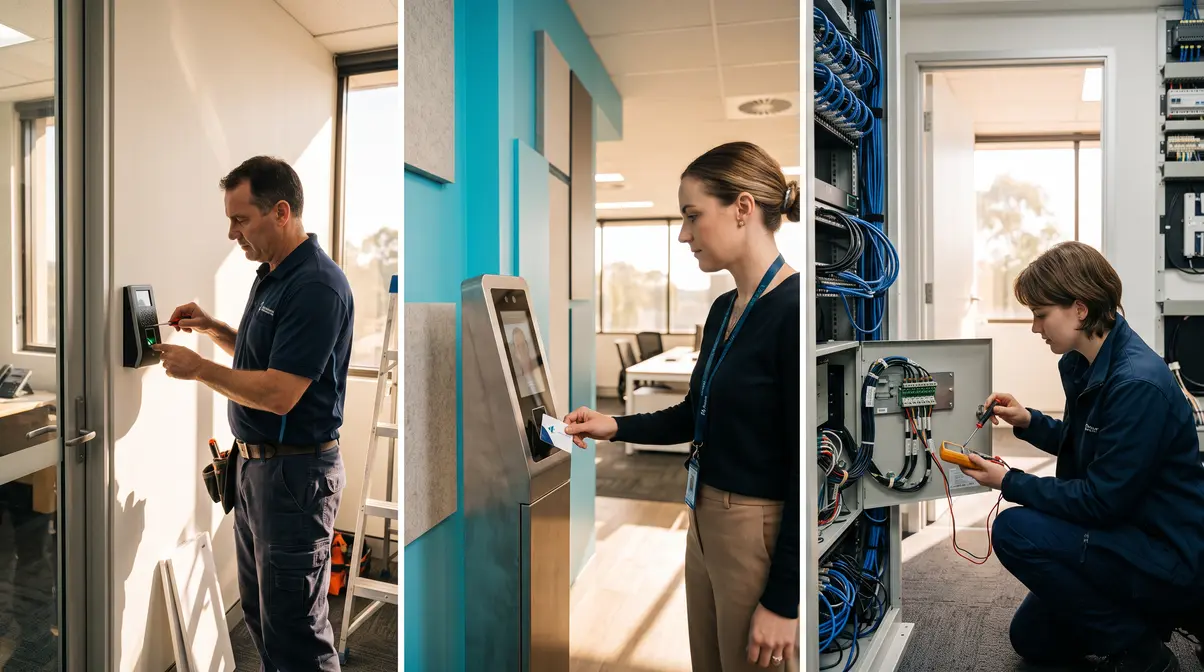
Master biometric access control Perth compliance in 2026. Explore Australian privacy laws, avoid legal risks, and compare the best security brands today.
Table of Contents
Biometric Access Control Perth: Modern Commercial Security and Privacy Compliance
Commercial facilities across Western Australia are undergoing a fundamental transformation in physical identity verification. Traditional mechanical keys, plastic swipe cards, and PIN pads are increasingly vulnerable to credential cloning, theft, lost fobs, and unauthorized credential sharing (often referred to as “buddy punching”). Deploying robust Biometric Access Control Perth infrastructure allows small business managers to eliminate credential sharing while establishing an uncompromising, automated physical defence perimeter across commercial offices, warehouses, medical centres, and industrial facilities.
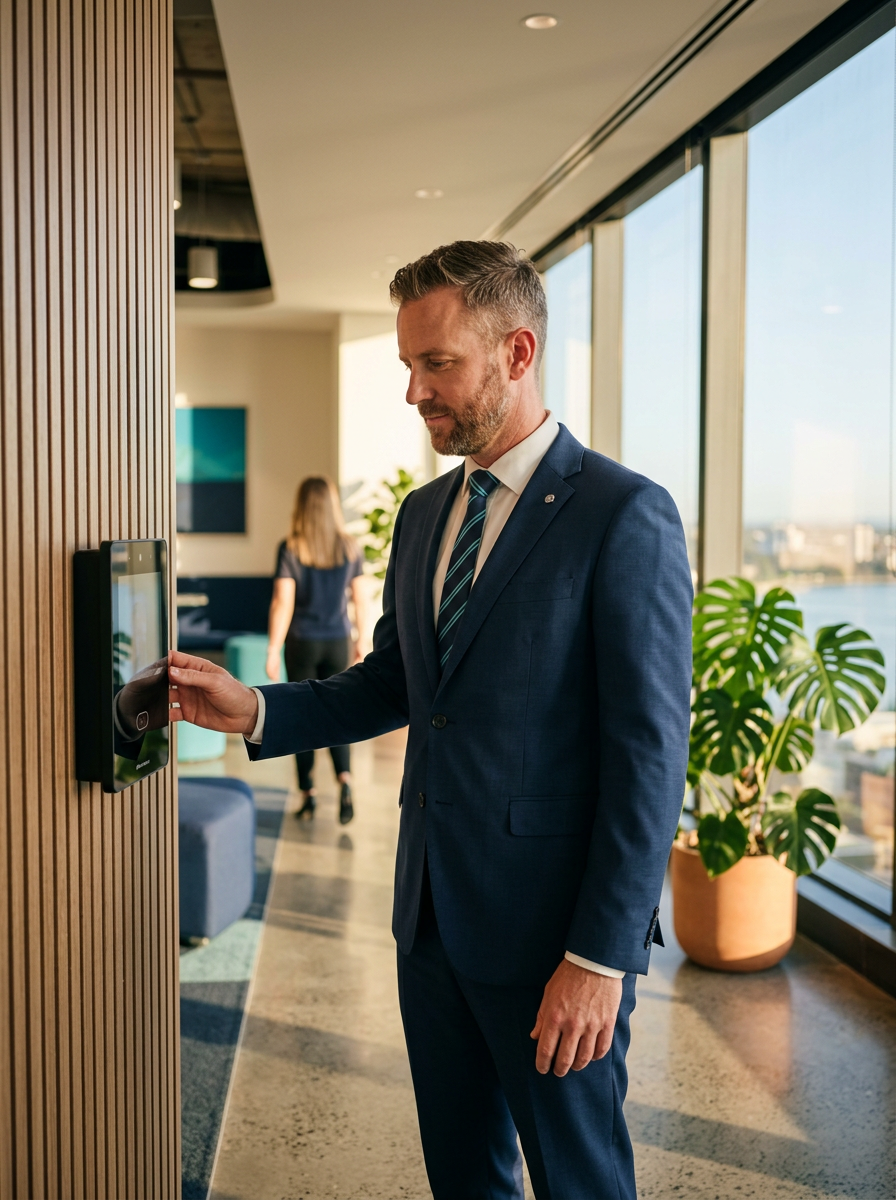
Biometric authentication verifies unique physiological characteristics—such as facial geometry, fingerprint friction ridges, or palm vein vascular patterns—to grant access. Because these physical markers cannot be transferred, forgotten, or easily duplicated, commercial biometric terminals provide unmatched risk mitigation for sensitive commercial areas. However, integrating biological credentials into a commercial security ecosystem introduces critical technical, architectural, and regulatory responsibilities.
At Smart SYS, we deliver an integrated Dual-Engine model combining enterprise-grade ICT Services (Telecommunication, VoIP, unified group communication, real-time collaboration, and network infrastructure) with dedicated Commercial Security Services (Alarms, CCTV, Access control, Fire Alarm, and Duress Alarm). By acting as your single point of accountability, we ensure that commercial access readers and IP surveillance cameras—both functioning as mission-critical network devices—communicate seamlessly across your local network architecture without the costly finger-pointing common between disparate IT and security contractors.
Australian Privacy Laws and Biometric Data Governance for Commercial Facilities
When establishing Biometric Access Control Perth protocols, commercial operators must understand that Australian privacy law treats biometric templates as sensitive personal information. Under the Privacy Act 1988 (Cth) and the Australian Privacy Principles (APPs), biometric data used for automated verification or identification carries substantially higher regulatory protections than standard business records.
Small business managers deploying biometric access hardware must adhere to fundamental compliance pillars to mitigate legal exposure and maintain ACCC compliance:
- APP 3 (Collection of Sensitive Information): Commercial entities must collect biometric data only with explicit, informed individual consent, and only when the data is reasonably necessary for core operational functions (such as site security, asset protection, and safety compliance).
- APP 6 (Use and Disclosure): Biometric identifiers captured for building access control cannot be repurposed, sold, or shared with third parties without explicit authorization, unless required by Australian law or law enforcement agencies.
- APP 11 (Security of Personal Information): Commercial organisations must take active, reasonable steps to protect biometric records from misuse, interference, loss, unauthorized access, modification, or disclosure.
Regulatory guidance from the Office of the Australian Information Commissioner (OAIC) emphasizes that raw biometric images—such as direct photographs of an employee’s face or uncompressed fingerprint scans—present acute privacy vulnerabilities if compromised. To comply with regulatory standards across Western Australia, Biometric Access Control Perth installations must rely on mathematical hashing rather than storing unencrypted raw biometric images.
Template Hashing vs. Raw Image Storage
Modern commercial biometric readers do not store actual photos or fingerprint graphics on the device or server. Instead, the terminal’s optical, capacitive, or infrared sensor captures specific nodal points (such as the distances between facial landmarks or the bifurcation points of fingerprint minutiae) and converts those coordinates into an irreversible, encrypted mathematical algorithm known as a biometric template.
If a mathematical template is ever intercepted, it cannot be reverse-engineered into a human face photograph or usable fingerprint image. At Smart SYS, we assure that our biometric solutions utilize hardware-level AES-256 or TLS 1.3 encryption on edge terminals, during network transit, and within access control management databases, strictly neutralizing credential theft risks.
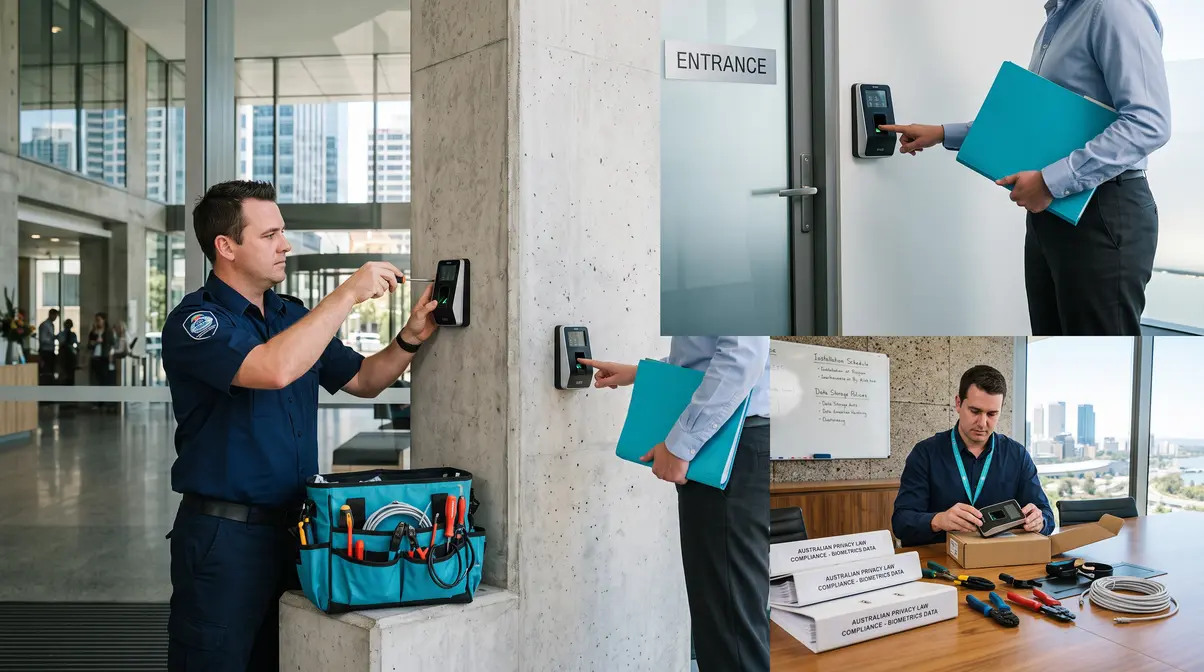
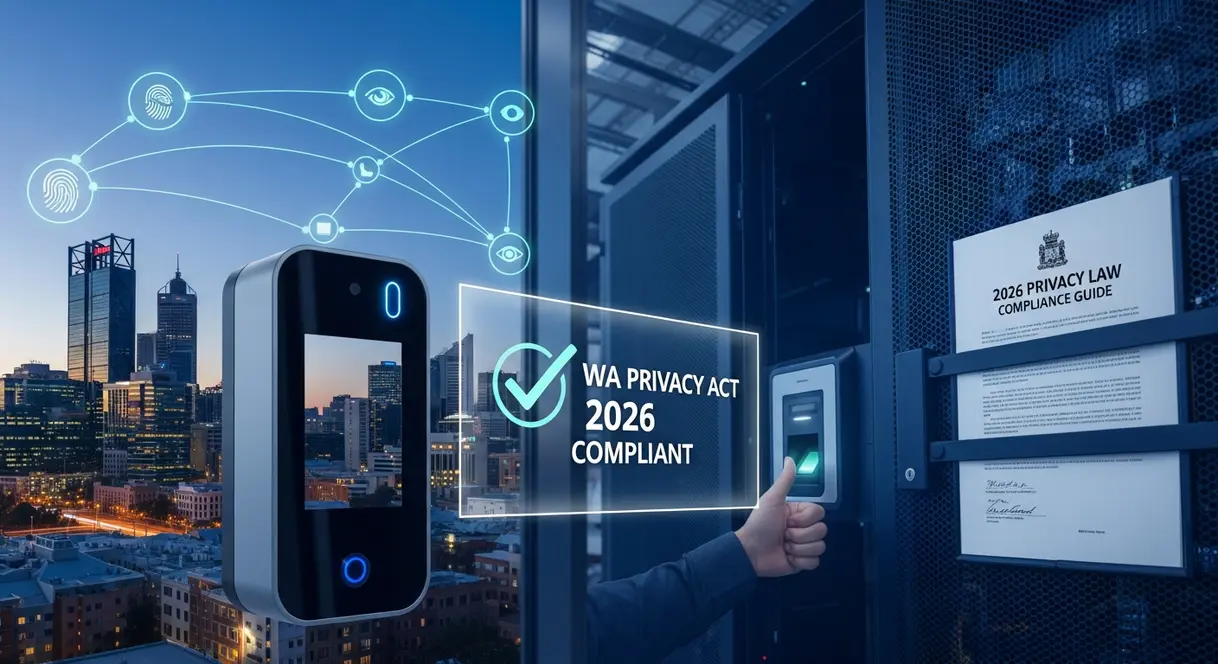
Evaluating Biometric Modalities: Facial Recognition, Fingerprints, and Wave Technology
Selecting the appropriate modality for Biometric Access Control Perth facilities requires balancing throughput speed, environmental durability, and false rejection rates. Different operational environments across Perth—from sterile corporate boardrooms in the CBD to dusty logistics hubs in Welshpool and coastal workshops in Henderson—demand purpose-engineered biometric sensing hardware.
| Biometric Modality | Throughput Speed | Spoof Resistance | Environmental Resilience | Primary Commercial Use Case |
|---|---|---|---|---|
| 3D Facial Recognition | Under 0.3 seconds | Very High (Dual-Lens + IR) | High (Indoor / Sheltered Outdoor) | Corporate offices, cleanrooms, high-traffic main entry foyers. |
| Multispectral Fingerprint | 0.8 – 1.2 seconds | High (Sub-surface scanning) | Moderate to High | Server rooms, executive suites, internal secure storage. |
| Touchless 3D Palm / Wave | Under 0.2 seconds | Maximum (Subdermal Vascular) | Extremely High (Contactless) | Food manufacturing, medical facilities, dusty industrial gates. |
1. 3D Facial Recognition Terminals
Modern facial recognition devices project infrared structured light patterns across thousands of points on the human face, capturing depth, cheekbone contours, and eye-socket depth. Integrated dual-camera vision systems combine RGB visible light imaging with thermal or infrared depth sensors to deliver advanced “liveness detection.” This anti-spoofing mechanism ensures that printed photographs, high-resolution tablet screens, or silicone 3D masks cannot deceive the terminal.
2. Multispectral & Optical Fingerprint Scanners
While standard optical fingerprint sensors capture only surface skin ridges (which can fail if fingers are wet, dirty, or abraded from physical labour), commercial multispectral fingerprint readers project multiple wavelengths of light into the skin to scan sub-surface vascular structures. This provides superior authentication accuracy even in demanding commercial environments.
3. Touchless Palm Vein and Hand-Wave Scanners
Touchless wave technology allows users to simply swipe their hand through an open sensor array without touching any physical surface. Near-infrared light illuminates the deoxygenated hemoglobin in the palm’s vein network, capturing a complex, completely internal biometric signature that is virtually impossible to forge. These readers are ideal for industrial or medical settings where hygiene and rapid throughput are paramount.
Top Commercial Biometric Access Control Brands Reviewed for 2026
Small business managers exploring Biometric Access Control Perth hardware will find several market-leading platforms tailored for commercial environments. Choosing the correct brand ensures long-term firmware support, high-availability hardware reliability, and seamless integration into our broader Security Services (CCTV, Alarms, Access Control) ecosystem.
1. Suprema (BioStation 3, FaceStation F2, BioLite N2)
Suprema represents an international benchmark in edge biometric authentication. Their flagship units combine compact IP65/IK07 weatherproof enclosures with embedded NPU (Neural Processing Unit) artificial intelligence. The Suprema BioStation 3 supports contactless facial recognition, RFID credentials, and mobile access via Apple Wallet or Android NFC. With onboard template encryption and full Open Supervised Device Protocol (OSDP) compliance, Suprema hardware integrates natively into high-security commercial topologies.
2. IDEMIA (MorphoWave & VisionPass)
IDEMIA is renowned for frictionless, high-throughput security. The MorphoWave reader scans four fingerprints in 3D with a single touchless hand wave in less than one second, processing up to 50 users per minute through turnstiles or commercial speed gates. For critical infrastructure, mining corporate offices, and data centres across Perth, IDEMIA delivers market-leading false acceptance rate (FAR) protection.
3. Gallagher Security & Inner Range Integriti Integration
For enterprise-scale commercial sites, integrating biometric readers directly into building management and unified access platforms like Inner Range Integriti or Gallagher Command Centre provides centralised credential management. These controllers process biometric verification results across complex multi-door lock schedules, lift destination controls, and automated fire release triggers.
4. Hikvision Commercial MinMoe Terminals
For small-to-medium commercial offices seeking high-value facial recognition combined with two-way intercom capabilities, Hikvision MinMoe terminals offer an accessible entry point. Featuring deep-learning algorithms, 99% recognition accuracy, and sub-0.2 second verification speeds, these units serve dual purposes as biometric door controllers and visitor video entry stations.
5. UniFi Access by Ubiquiti
UniFi Access provides a more ecosystem-focused approach to commercial access control. Compatible readers support authentication methods including NFC, mobile credentials, PIN, facial recognition and fingerprint, depending on the model. Its integration with UniFi networking and surveillance makes it an increasingly relevant option for offices, retail, warehouses and small-to-medium commercial sites.
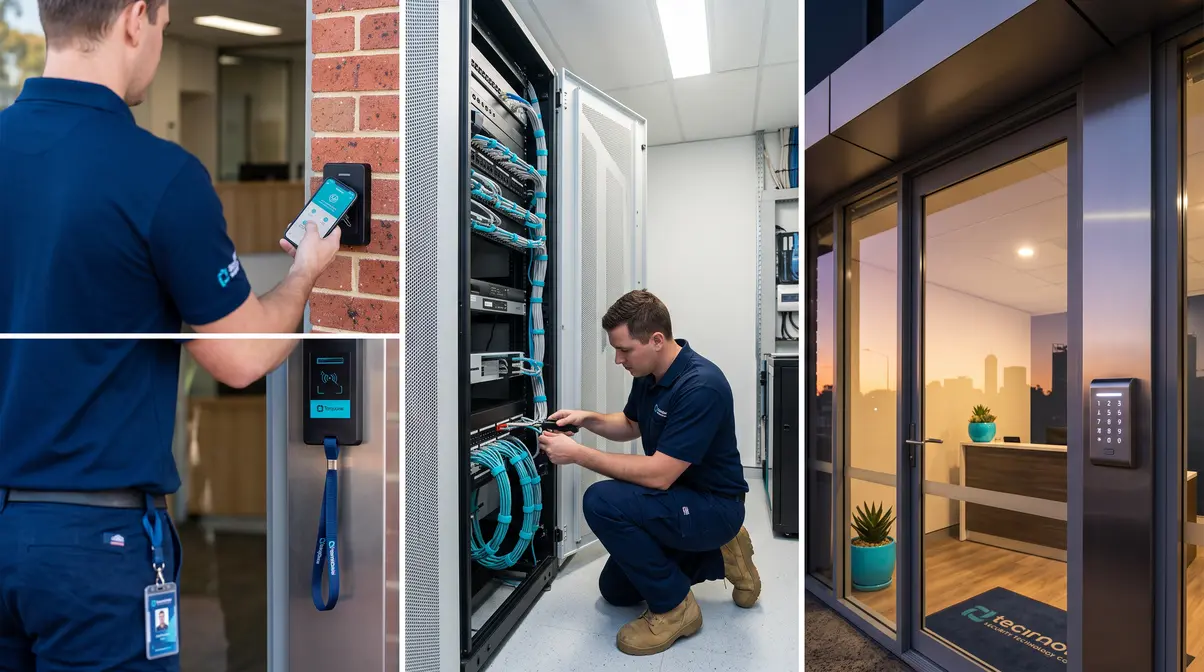
Network Architecture, PoE, and Cabling Standards for Biometric Terminals
Because commercial access readers and CCTV cameras operate as connected edge network devices, architecting Biometric Access Control Perth demands a resilient structured cabling backbone. Unlike intrusion alarms—which operate as dedicated input/output signal circuits rather than active network devices—biometric readers communicate continuously over TCP/IP networks to synchronise credential databases, update access permissions, and log audit trails.
A dependable Biometric Access Control Perth deployment relies strictly on quality Cat5E or Cat6 Ethernet cable, avoiding cheap, non-certified cable and poor quality connectors. Inferior copper-clad aluminium (CCA) cables or sub-standard RJ45 terminations introduce packet loss, signal latency, and voltage drops that cause biometric terminals to drop off the local network, lock up, or fail during real-time identity matching.
OSDP v2.2 vs. Legacy Wiegand Communication
Legacy access control systems frequently used the unsecured Wiegand protocol to transmit credential data from the door reader to the controller. Wiegand transmits unencrypted plain-text data across multi-core cables, exposing facilities to physical packet-sniffing and replay attacks. At Smart SYS, we mandate Open Supervised Device Protocol (OSDP v2.2 with Secure Channel Protocol) or direct encrypted IP communication. OSDP utilizes AES-128 encryption, bidirectional communication, and constant line supervision to detect if any wiring has been tampered with or intercepted.
Network Segmentation and Virtual Local Area Networks (VLANs)
Our dual-engine ICT engineering protocols dictate that all physical security network devices (Access Control and Commercial CCTV) operate within an isolated, dedicated Security VLAN. This prevents unauthorized personnel on corporate Wi-Fi or guest networks from accessing terminal web interfaces. By deploying managed Layer-3 PoE+ switches (802.3at) with 802.1X port authentication and firewall rules, we eliminate lateral network traversal threats.
Installation Complexity, Building Integrity, and Infrastructure Assessment
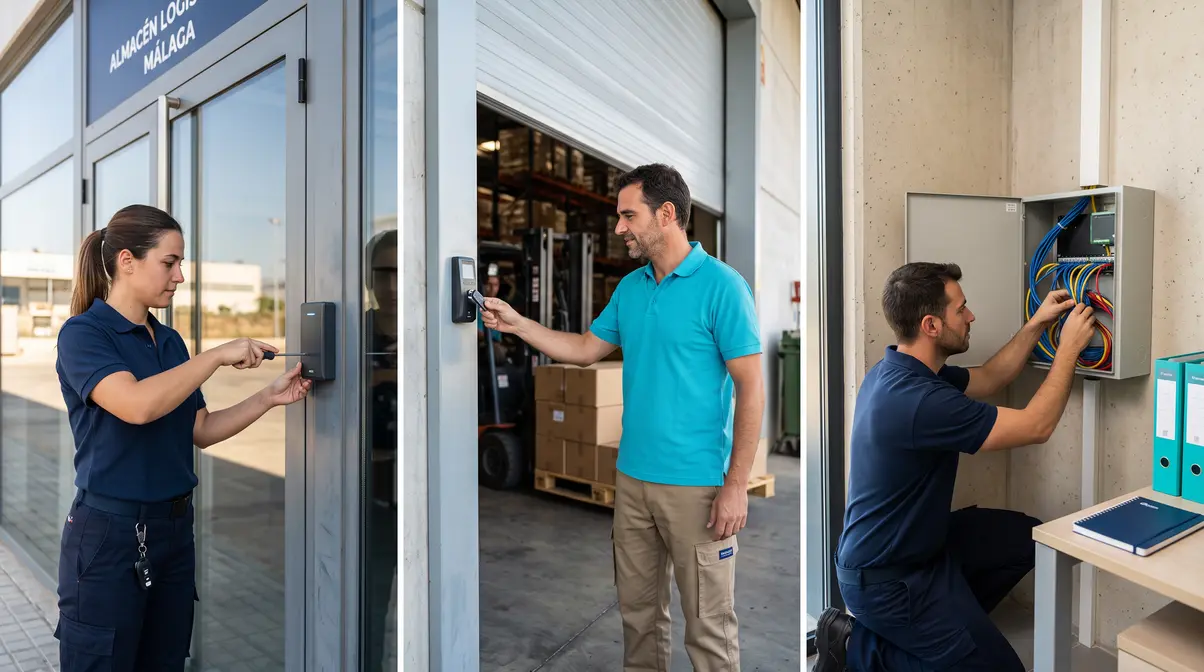
Physical deployment of Biometric Access Control Perth requires careful evaluation of installation complexity, structural substrates, and building integrity. Commercial facilities across Perth present diverse architectural challenges, ranging from modern tilt-panel concrete warehouses in Canning Vale to heritage limestone buildings in Fremantle and glass-fronted executive towers along St Georges Terrace.
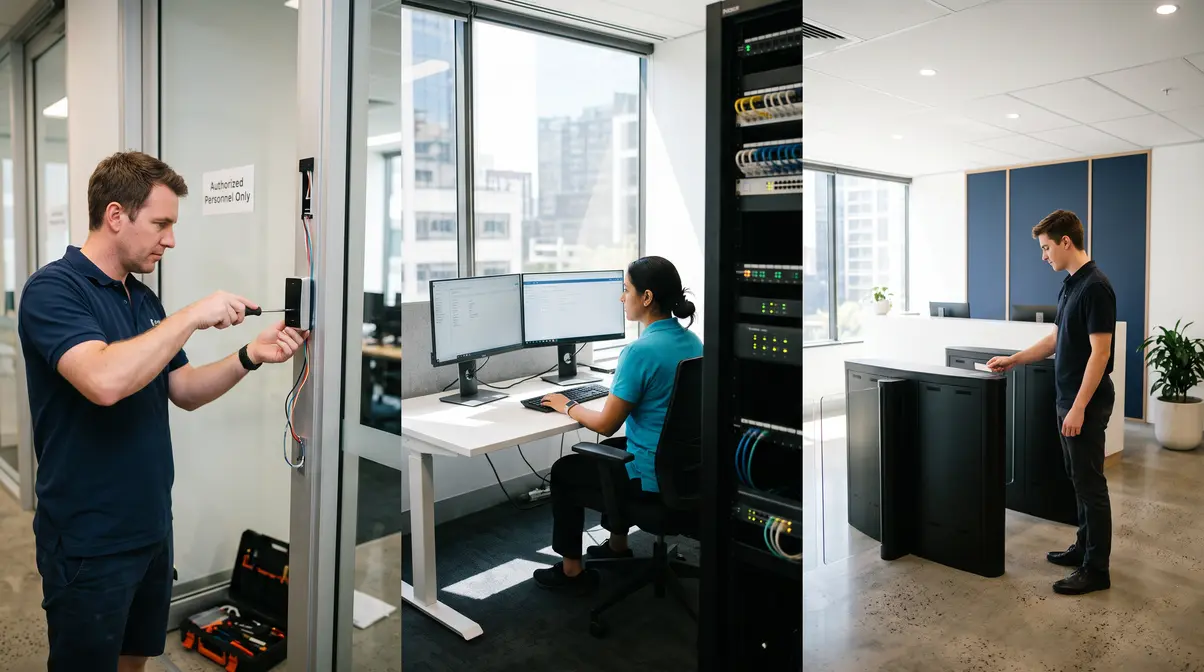
Our licensed technicians know precisely how to avoid damages to the building during cable containment, core drilling, and frame preparation. We conduct a comprehensive site assessment to determine how to leverage existing infrastructure safely, or design new pathways when retrofitting older properties:
- Cavity Wall and Plasterboard Installation: Cables are carefully fished through internal wall studs and dropped cleanly into flush-mounted low-voltage brackets, preserving existing wall finishes and acoustic ratings.
- Exposed Brick and Solid Masonry: Where internal wall cavities do not exist—such as exterior double-brick facades or industrial workshops—we install heavy-duty, colour-matched rigid steel or UV-stabilised PVC conduit to protect the cabling from physical tampering and harsh Western Australian sun exposure.
- Glass Partitions and Aluminium Mullions: For modern commercial office entries featuring full-height architectural glass, our specialists utilize slimline mullion-mount biometric readers or specialized concealed ribbon cables within structural aluminium window framing.
Power Budgets and Fail-Safe Lock Hardware
Biometric terminals with integrated colour touchscreens, infrared illuminators, and optical heaters draw significantly more operational current than standard proximity card readers. We architect robust power distribution topologies incorporating monitored auxiliary power supplies with backup battery storage (Float-charged Sealed Lead Acid or LiFePO4). This ensures that if mains power fails, the commercial locking mechanisms—whether electric mortise locks, electromagnetic shears, or motorized drop bolts—fail into their designated life-safety state (Fail-Safe for emergency egress paths or Fail-Secure for high-security asset rooms) in full compliance with National Construction Code (NCC) standards.
Commercial Investment and Cost Factors in Perth
When planning commercial budgets, the cost of Biometric Access Control Perth starts from base equipment thresholds rather than unpredictable recurring overheads. Unlike proprietary cloud-only residential systems that enforce high recurring user subscription fees, commercial systems deployed by Smart SYS have no or minimal ongoing monthly fees, ensuring a low total cost of ownership (TCO).
For small business managers seeking a detailed financial breakdown of commercial door security, explore our comprehensive guide on Access Control Cost Perth. Investment levels depend on specific technical variables:
- Entry-Level Single-Door Biometric Terminal: Starting from $1,850 (includes commercial standalone biometric reader, power supply, electric strike lock, egress hardware, and certified Cat6 cabling within standard wall cavities).
- Enterprise Integrated Multi-Door Biometric System: Starting from $3,400 per door (includes centralised multi-door controller, OSDP dual-authentication 3D facial terminals, electrified mortise hardware, fire release integration, and full network provisioning).
- Touchless High-Throughput Turnstile / Palm Solutions: Starting from $6,500 per lane (includes high-speed optical turnstiles or wave sensors engineered for high-density entry control).
The Dual-Engine Advantage: Why ICT and Security Convergence Matters
The traditional separation between physical security installers and corporate IT departments is the leading cause of failed commercial security projects. In typical commercial fit-outs, when a facial recognition reader fails to authenticate users or experiences network disconnects, the security contractor blames the IT provider’s firewall, while the IT provider blames the security contractor’s hardware.
By integrating ICT network engineering with commercial physical security, our Biometric Access Control Perth solutions bridge the gap between network infrastructure and physical perimeter protection. As your single point of accountability, Smart SYS eliminates the contractor blame game:
- Network Infrastructure & Security Integration: We configure the physical access readers, controllers, managed PoE switches, core routing, subnets, and VLAN firewall ACLs under one unified architectural plan.
- Unified Real-Time Communications: We bridge biometric door entry stations directly into your commercial VoIP phone systems, unified group communication platforms, and real-time collaboration tools, enabling staff to answer video entry calls and release doors from desk IP phones or mobile applications.
- Multi-Layered Security Synchronisation: Access events instantly trigger automated PTZ camera presets. High-quality CCTV systems provide clear, evidentiary-grade footage that supports accurate incident verification and liability protection without requiring manual correlation across separate systems.
Step-by-Step Deployment Roadmap for Small Business Managers
Successfully implementing biometric security requires a methodical, compliance-focused deployment plan. We guide commercial clients through a four-stage engineering roadmap:
Step 1: Privacy Impact Assessment & Workplace Policy
Before installing biometric hardware, commercial managers must formulate a written workplace policy detailing why biometric data is collected, how mathematical templates are secured, and the data retention/deletion timelines. Staff and contractors must receive formal notice, and alternative access arrangements (such as encrypted mobile credentials or PINs) should be provided for individuals who elect not to enrol biometric data.
Step 2: Physical Site Survey & Cabling Assessment
Our specialists inspect all door frames, architectural substrates, ingress/egress routes, and network distribution closets. We assess the building’s existing infrastructure, identify fire exit compliance mandates, plan cable pathways using certified Cat5E or Cat6 Ethernet cable, and calculate precise PoE+ power budgets.
Step 3: Hardware Installation & Encrypted Configuration
Our technicians mount and terminate biometric terminals, electrified architectural locks, break-glass emergency exit buttons, and door position switches. All edge readers are configured via OSDP v2.2 or encrypted IP, and all network connections are isolated within your secure VLAN.
Step 4: User Enrolment, Testing, and Lifecycle Maintenance
Biometric credentials are authenticated through an administrative enrolment station. The system undergoes rigorous stress-testing, simulating power loss, fire alarm overrides, anti-tailgating scenarios, and spoofing attempts. Ongoing firmware updates are scheduled to assure long-term protection against evolving security vulnerabilities.
Frequently Asked Questions About Biometric Access Control in Western Australia
Can employees legally refuse to use biometric access systems in Western Australia?
Yes. Under the Australian Privacy Act and fair work jurisprudence, biometric data collection requires voluntary consent. If an employee or commercial contractor declines biometric enrolment, commercial operators must provide a reasonable, secure alternative—such as an encrypted smart card, mobile NFC token, or PIN code—without imposing disciplinary penalties.
What happens to biometric doors during a power failure or building fire alarm?
All commercial access control installations engineered by Smart SYS strictly comply with Western Australian fire safety and building egress regulations (AS 1428 and NCC). All emergency exit doors fitted with fail-safe electric locking mechanisms automatically cut locking power and release upon fire alarm activation or loss of main power. Furthermore, mechanical green break-glass emergency release units are installed directly on the secure side of every controlled egress pathway to assure unhindered exit.
Can high-resolution photos or deepfake videos fool modern facial recognition terminals?
No. Commercial-grade facial recognition terminals utilize dual-lens optical configurations paired with active infrared depth sensors and machine learning algorithms to perform real-time liveness detection. They analyze skin texture, 3D facial depth, eye blinks, and thermal emissions. Flat photos, smartphone screens, printed masks, and digital video replays lack 3D spatial depth and infrared reflection, causing the reader to immediately reject the spoof attempt.
Are biometric templates stored in the cloud or locally at the Perth facility?
Depending on your corporate security architecture, biometric mathematical templates can be stored locally on encrypted on-premises controllers, distributed securely to the internal storage of the edge readers themselves, or maintained in an Australian-hosted private cloud server protected by end-to-end AES-256 encryption. Raw images are never stored.
Securing Your Commercial Perimeter with Smart SYS
Modern commercial operations require high-assurance physical defence that moves beyond easily lost plastic fobs and compromised keys. Investing in licensed Biometric Access Control Perth delivers unmatched risk mitigation, rapid throughput, and seamless commercial entry management while maintaining full compliance with Australian privacy standards.
Whether you are upgrading an existing multi-tenant commercial office, securing a warehouse logistics facility, or building a new medical centre in Perth, Smart SYS provides the complete dual-engine advantage. Contact our senior ICT and commercial security specialists today to schedule an exhaustive on-site infrastructure assessment and discover the power of unified, enterprise-grade access control.
Frequently Asked Questions
Is biometric data stored as actual photos or fingerprint images?
No. Commercial biometric systems do not store raw photographs or direct fingerprint graphics. Edge readers scan key nodal coordinates or minutiae points and convert them into an encrypted, irreversible mathematical template (hash). If this data is intercepted, it cannot be reverse-engineered into an actual image, ensuring robust alignment with the Australian Privacy Act 1988 and Australian Privacy Principles.
What happens if an employee or contractor refuses biometric enrolment?
Under Australian privacy laws, collecting biometric data requires explicit, voluntary consent. If a worker or contractor declines biometric registration, commercial facilities must provide an alternative, secure authentication method—such as an encrypted RFID access card, mobile NFC token, or PIN code—without enforcing workplace penalties.
How do biometric access systems behave during power outages or fire emergencies?
Commercial installations designed to Western Australian NCC and AS 1428 compliance standards integrate float-charged backup batteries and fail-safe locking architecture. Upon fire alarm activation or total mains power loss, power to electrified locks on egress paths is automatically severed to allow unhindered escape, complemented by physical break-glass emergency release units.
Can modern facial recognition terminals be spoofed by photos or phone screens?
No. Enterprise-grade biometric terminals employ dual-lens optics alongside infrared depth mapping and AI-driven liveness detection. Because they analyse sub-surface light reflection, facial geometry, and thermal characteristics in three dimensions, flat photographs, tablet video playbacks, and silicone masks are instantly detected and rejected.
Upgrade Your Perth Facility with Compliant Biometric Access Control
Protect your organisation with industry-leading biometric security tailored to Australian privacy regulations. Partner with our local security specialists for robust, enterprise-grade access control.
Post Comment