Active Directory Access Control: The Ultimate 2026 Guide

Unlock a safer, smarter office for 2026. Our guide to Active Directory access control shows you how to seamlessly integrate physical and digital security.
Table of Contents
The Blame Game Ends Here: Unifying Your Office Access in 2026
Picture this common scenario for small business managers in Perth. A new employee starts on Monday. Our ICT team has their computer, email, and network access ready to go. But when they try to enter the office, their access card is declined. A frantic call is made to the separate security contractor, who says they never received the request. The result? Wasted time, a poor first impression, and a glaring security process gap. Conversely, when an employee is terminated, their network access is cut immediately, but their physical access card remains active for hours—or even days—creating a significant risk. This disconnect, the “blame game” between IT and security providers, is a problem we see constantly. It’s inefficient, insecure, and entirely avoidable.
This is precisely why Active Directory Access Control is no longer a luxury for large corporations but an essential strategic tool for forward-thinking Perth businesses. It’s about creating a single, authoritative source for who gets access to what, both digitally and physically. As a leading integrated ICT & Security agency, we’ve built our entire service model on eliminating these gaps. In this guide, we’ll break down exactly what this means for you, how it works, and why it’s the foundation of a modern, secure, and efficient commercial environment.
Deconstructing the Components: What Are We Actually Integrating?
To understand the power of integration, we must first understand the two core components. For years, these systems have been managed in complete isolation, creating the very problems we aim to solve. At Smart SYS, our Dual-Engine model, encompassing both ICT Services and Security Services, treats them as two sides of the same coin.
Microsoft Active Directory (AD): The Digital Gatekeeper
For most commercial operations, Microsoft’s Active Directory is the heart of the ICT network. In simple terms, think of it as the central database or digital phonebook for your entire organisation. It holds all user accounts, passwords, and, most importantly, permissions. It’s the system that dictates whether an employee can log into their computer, access the shared “Finance” folder, or use specific unified group communication tools. Our ICT services, which include Telecommunication, VoIP, and network infrastructure, all rely on AD to function securely and efficiently. It’s the single source of truth for all digital identity and access within your network.
Commercial Access Control Systems: The Physical Gatekeeper
A commercial access control system is what manages physical entry to your premises. This includes the card readers on the wall, the electronic locks on the doors, and the control panels that connect them. Unlike a basic alarm system, which is not a network device, a modern access control system is a sophisticated network device. It communicates across your network infrastructure to make real-time decisions about granting or denying entry based on a credential (like a card or fob). This system is a critical layer in your physical security posture, working alongside solutions like our commercial CCTV and Duress Alarm services to provide comprehensive protection and risk mitigation.

The Power of Integration: What is Active Directory Access Control?
Now, let’s bring those two worlds together. Active Directory Access Control is the strategy and technology used to link your physical access control system directly to your IT network’s Active Directory. Instead of managing two separate lists of people and permissions—one for computers and one for doors—you manage only one: Active Directory. When a change is made in AD, it is automatically and seamlessly synchronised to the physical security system.
The result is a streamlined and highly secure approach to managing permissions across your entire business. This is the essence of our “Single Point of Accountability” promise. There is no longer an IT provider to blame for network issues or a security provider to blame for access card failures. There is just one integrated system, managed by one expert team that understands both domains. We architect the solution from the ground up to assure seamless communication between the digital and physical realms, eliminating the gaps where risks and inefficiencies thrive. True integration means the system works as one cohesive whole.
Transforming Operations: The Real-World Benefits for Your Perth Business
For small business managers, the practical benefits of a unified system are immediate and profound. It moves security from a reactive, manual process to a proactive, automated one.
Streamlined Onboarding and Offboarding
The most compelling benefit is the radical simplification of employee lifecycle management.
- Onboarding: When your HR or IT team creates a new user account in Active Directory for a new starter, they add them to the appropriate security groups (e.g., “Sales Team,” “All Staff”). Our integrated system sees this change. It automatically provisions their physical access card with permissions for the front door, the sales floor, and other common areas—all without a single extra step. No separate emails, no phone calls, no delays.
- Offboarding: This is where the risk mitigation is most critical. When an employee leaves, the standard procedure is to disable their Active Directory account. With a unified Active Directory Access Control system, this single action instantly revokes their network login AND deactivates their physical access card. The security hole is closed in seconds, not days, drastically reducing the risk of unauthorised post-employment access.
Enhanced Security & Granular Control
The cornerstone of modern Active Directory Access Control is the principle of Role-Based Access Control (RBAC). You’re no longer managing individual permissions for dozens or hundreds of doors and employees. Instead, you manage roles.
- Create groups in Active Directory that mirror your organisational structure: “Finance,” “Marketing,” “Warehouse,” “Management.”
- Assign physical access levels to these groups. For example, the “Finance” group gets 24/7 access to the main office and the finance department, while the “Warehouse” group gets access to the loading bay and warehouse doors between 7 am and 6 pm on weekdays.
- When an employee moves from Marketing to Finance, you simply change their group membership in Active Directory. Their physical access rights are updated automatically. This ensures people only have access to the areas they absolutely need, a core principle of strong security and Defence in depth.
Operational Efficiency & A Single Point of Accountability
The administrative savings are significant. Your team no longer performs duplicate data entry, which is not only time-consuming but also a major source of human error. Auditing becomes simpler, as you can pull a single report showing a user’s entire access history, both digital and physical. But the ultimate efficiency comes from eliminating friction. As we detail in our 2026 accountability model for Perth businesses, when the systems are unified, so is the responsibility. You have one number to call. We, as your single point of accountability, take full ownership of the entire ecosystem, from the network switch to the door reader.
How Does Active Directory Access Control Work Under the Hood?
While the concept is powerful, the execution requires genuine expertise. For business managers, it’s not essential to know every technical detail, but understanding the basics helps in appreciating why a professional setup is vital.
The integration works through a process of synchronisation. The software for the commercial access control system is configured to securely communicate with your Active Directory server, typically using a standard protocol called LDAP (Lightweight Directory Access Protocol). Periodically—often every few minutes—the access control software queries AD, asking for an updated list of users and their group memberships.
During the initial setup, we map your Active Directory “Security Groups” to “Permission Levels” within the access control system. This mapping is the critical link. From that point on, the system intelligently handles the updates, ensuring the permissions on the door controllers always reflect the information in AD. Architecting this correctly from the start is paramount. A deep appreciation for understanding the crucial relationship between security and IT solutions is what prevents the performance bottlenecks and security loopholes that plague poorly planned systems. This is the difference between a set-and-forget solution and a constant maintenance headache, and it’s where our dual-engine expertise becomes your greatest asset for a robust Active Directory Access Control implementation.
Common Pitfalls and Why Professional Installation is Non-Negotiable
A unified access system is only as strong as its weakest link. We often get called in to fix failed projects where corners were cut. Here are the most common points of failure.
The Network is the Backbone
An effective Active Directory Access Control system relies completely on a stable and secure network.
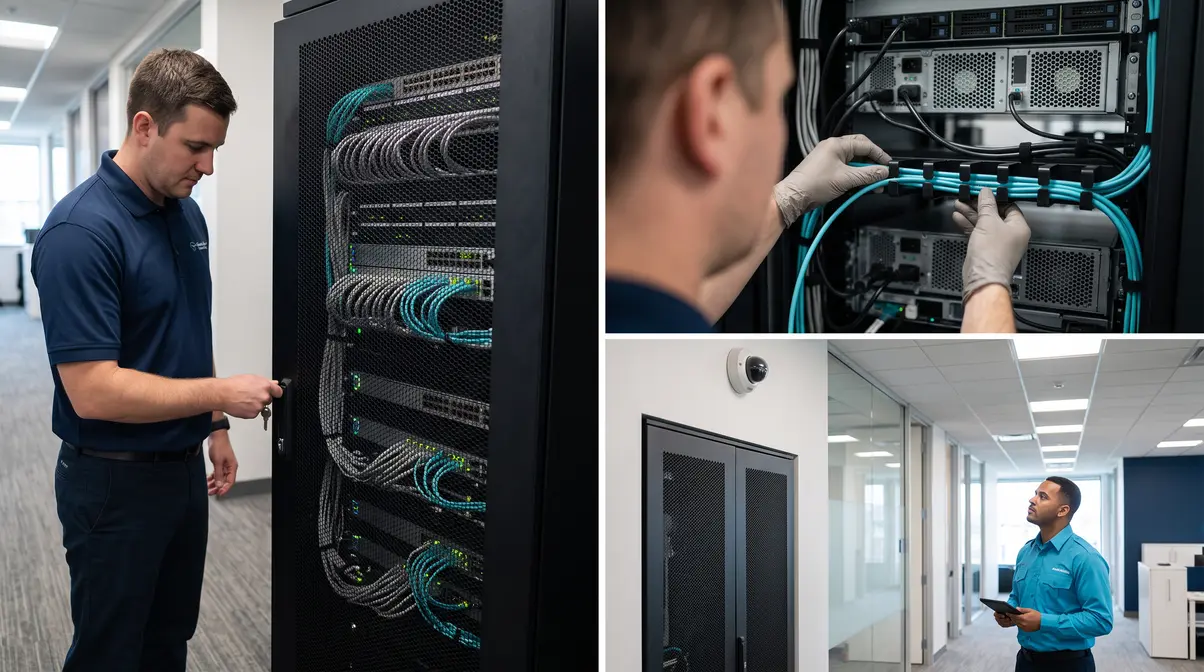
- Cabling: We cannot overstate the importance of high-quality cabling. We exclusively use properly certified Cat6 or Cat6a Ethernet cable. We’ve seen systems fail because a contractor used cheap, non-certified cable with poor quality connectors that couldn’t handle the data traffic, causing the sync to fail and leaving staff locked out.
- Network Configuration: The access control panels and servers must be on the correct, secure network segment. Improper network design can expose your security system to threats or cause communication breakdowns.
Installation Complexity and Building Integrity
Running the physical cables is a skilled trade. Our licensed professionals are trained to perform installations with minimal aesthetic impact and without causing structural issues. We know how to navigate the challenges, whether it’s running exposed conduit on external brick or concealing cabling within delicate internal wall cavities. We also perform a careful assessment of your building’s existing infrastructure before any work begins to assure it can support the new system. Our goal is to enhance your building, not create repair work by causing damages to the building.
Software Misconfiguration
The final piece of the puzzle is the software that bridges AD and the access controllers. A small misconfiguration in the sync schedule, the user filters, or the security credentials can cause the entire system to fail. It might fail “open,” leaving doors unlocked, or fail “closed,” creating chaos. This is where our deep ICT knowledge is critical; we don’t just install the security hardware, we understand the server-side software and network protocols required to make the integration flawless and secure.

The Future is Hybrid: On-Premise AD and Microsoft Entra ID
The world is moving towards the cloud, and identity management is no exception. Many of our clients use Microsoft 365, which is powered by Microsoft Entra ID (the new name for Azure Active Directory). This is essentially Active Directory for the cloud. The good news is that modern commercial access control systems are built for this hybrid world. They can integrate with a traditional on-premise AD server, a cloud-only Entra ID environment, or a hybrid setup that syncs between the two. This ensures that your investment in a unified system today is future-proof. Embracing these modern Active Directory Access Control strategies is a key part of adhering to recognised cybersecurity frameworks, which increasingly call for robust identity and access management. A core part of this is implementing robust access control measures as recommended by the Australian Cyber Security Centre to restrict access to systems and data based on user duties.
Your Next Steps Towards a Truly Smart System
We’ve covered a lot of ground, but the core message is simple: A properly implemented Active Directory Access Control solution is one of the most powerful investments a Perth small business manager can make to simultaneously boost security, reduce risk, and improve operational efficiency.
It’s time to end the blame game and demand a single point of accountability from your provider. At Smart SYS, our integrated ICT and Security teams work as one to design and deploy these systems every day. We don’t believe in off-the-shelf packages, as every business has unique needs. Our process begins with a comprehensive site assessment to understand your operational workflows and physical layout. Based on this, we architect a custom solution for implementing a true Active Directory Access Control solution that aligns with your goals and budget. Our commercial systems are designed to have no or minimal ongoing monthly fees, providing a clear and predictable return on investment. If you’re ready to experience the peace of mind that comes from a truly unified system, contact us for a consultation. We can provide a tailored quote for solutions starting from $X that will serve as the secure foundation for your business for years to come.
Frequently Asked Questions
What is Active Directory Access Control in simple terms?
In simple terms, it’s linking your office’s physical door access system directly to your IT network’s main user database (Microsoft Active Directory). This means you only have to manage one list of staff. When you create a new computer user, they automatically get door access. When you disable a user, their physical access card is instantly deactivated at the same time.
What’s the main security benefit of integrating access control with Active Directory?
The biggest security benefit is the immediate and automatic revoking of physical access when an employee leaves. The standard IT process is to disable a user’s account in Active Directory. With an integrated system, this single action also deactivates their physical access card in real-time, closing a major security gap that could otherwise remain open for hours or days.
Can this system work with cloud services like Microsoft 365?
Yes, absolutely. Modern commercial access control systems are designed for the hybrid world. They can integrate with traditional on-premise Active Directory servers as well as cloud-based identity platforms like Microsoft Entra ID (formerly Azure AD), which powers Microsoft 365. This ensures your investment is future-proof as your business moves more services to the cloud.
Why is professional installation so important for this kind of system?
Professional installation is non-negotiable because the system’s reliability depends on both the ICT network and the physical security hardware working together perfectly. Common pitfalls from non-specialist installations include using poor quality network cabling, incorrect network configuration, and software misconfiguration. These errors can lead to the entire system failing, either locking staff out or leaving doors unsecured.
Future-Proof Your Active Directory Security
Managing Active Directory is complex and critical for your business security. Instead of just reading the guide, let our experts implement a robust, future-ready strategy for you. We provide complete ICT and network support to keep your systems secure, efficient, and compliant.

Post Comment