Pro Comms Cabinet Setup: 2026 Security Best Practices
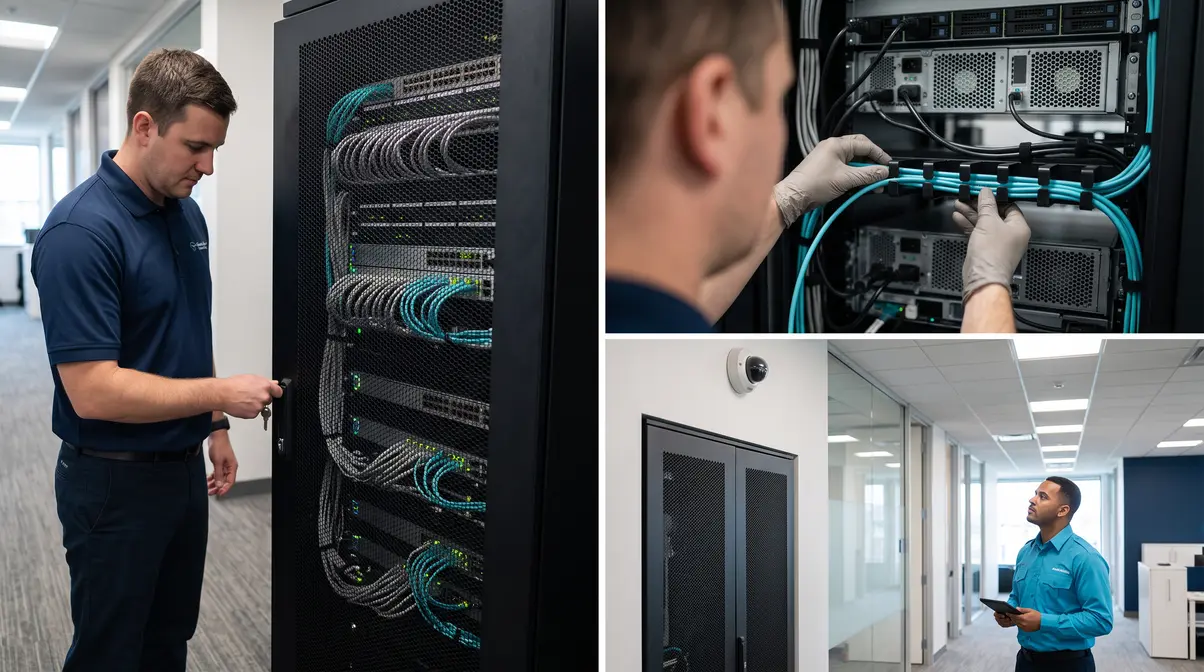
Need a pro comms cabinet setup? Our 2026 guide covers the best practices for safely housing vital IT and security hardware to protect your assets.
Table of Contents
Why Your Comms Cabinet Setup is Mission-Critical for 2026 and Beyond
For many small business managers in Perth, the communications cabinet is an out-of-sight, out-of-mind metal box tucked away in a storeroom. However, this cabinet is the central nervous system of your entire commercial operation. It’s where your digital world converges, housing the critical hardware that powers your network, communications, and security. A poorly planned or neglected comms cabinet setup is a significant liability, creating risks of downtime, security breaches, and costly, chaotic maintenance.
As we look towards 2026, the reliance on robust digital infrastructure has never been greater. Your ICT services—including Telecommunication, VoIP, and real-time collaboration tools—all depend on the equipment in this rack. Similarly, your modern security services, such as network-based CCTV and Access Control systems, rely on this same infrastructure. A professional comms cabinet setup is not an IT luxury; it’s a foundational pillar of business continuity and risk mitigation.
This is precisely where our unique Dual-Engine model at Smart SYS provides unparalleled value. We integrate our ICT Services and Security Services expertise, acting as your “Single Point of Accountability.” This eliminates the all-too-common blame game between separate IT and security contractors, assuring a cohesive and secure system from the ground up.
The Foundation: Choosing the Right Cabinet for Your Needs
The first step in any professional comms cabinet setup is selecting the correct enclosure. Choosing the wrong size or type of cabinet can hamstring your operations from day one and lead to significant problems down the line. It’s about more than just finding a box that fits; it’s about strategic planning for performance, security, and growth.
Size and Space Planning: Think Ahead
Cabinet height is measured in “Rack Units” (RU), with one RU equal to 1.75 inches. When selecting a size, a common mistake is only accounting for your current equipment. We advise our clients to plan for 3-5 years of growth. A good rule of thumb is to ensure you have at least 40-50% free space after the initial installation. This buffer accommodates future hardware, prevents overcrowding, and simplifies maintenance. Cabinet depth is equally important. You must account for the full depth of your deepest equipment (like servers), plus extra room at the rear for cable management and airflow—a minimum of 100-150mm is essential.
Cabinet Types: Wall-Mount vs. Freestanding
For smaller Perth offices or retail spaces where floor space is at a premium, a wall-mount cabinet (typically 6RU to 18RU) is an excellent solution. They keep equipment secure and off the floor. For larger commercial operations with more extensive hardware, a freestanding cabinet (from 22RU to 48RU) is the standard. These floor-standing racks offer greater capacity, depth options, and can be bolted to the floor for enhanced physical security, forming a critical part of the physical infrastructure.
Ventilation and Cooling: The Silent Killer of Hardware
Network switches, servers, and NVRs generate a significant amount of heat. Without proper ventilation, this heat becomes trapped, drastically shortening the lifespan of your expensive equipment and causing intermittent, hard-to-diagnose failures. A professional comms cabinet setup prioritises thermal management. Look for cabinets with perforated front and rear doors to allow for passive airflow. For denser installations, top-mounted fan trays are essential to actively exhaust hot air. The ambient temperature of the room itself is also a major factor, which is a key consideration in our holistic design process.
Power Management: The Lifeblood of Your System
Simply plugging everything into a single power board is a recipe for disaster. A professional rack requires a dedicated Power Distribution Unit (PDU). Basic PDUs provide multiple outlets, while more advanced “smart” or “switched” PDUs allow for remote monitoring of power consumption and even remote rebooting of individual outlets. Critically, the entire cabinet should be powered via a dedicated electrical circuit and protected by an Uninterruptible Power Supply (UPS). A UPS provides battery backup during a power outage, preventing data corruption and giving systems time to shut down gracefully.

The Art and Science of a Professional Comms Cabinet Setup
Once the right cabinet is chosen, the layout and organisation of the equipment inside is what separates an amateur job from a professional one. This is where our ICT and Security technicians’ expertise ensures optimal performance, security, and ease of maintenance for years to come. A logical and tidy installation is the hallmark of a quality comms cabinet setup.
Logical Equipment Layout for Performance and Cooling
There is a proven methodology to racking equipment that maximises efficiency and airflow:
- Top of Rack: Patch panels are placed here. This allows patch cords to be neatly routed downwards to the switches.
- Middle of Rack: Network switches are typically installed in the middle. This central position minimises the length of patch cables running from the patch panels above and the active equipment below.
- Bottom of Rack: The heaviest equipment, such as servers and especially the UPS units, should always be placed at the bottom. This provides a low centre of gravity, making the rack stable and safer to work on.
Your security hardware, like CCTV Network Video Recorders (NVRs) and Access Control panels, are integrated logically within this structure as they are core network devices.
Structured Cabling: The Backbone of Performance
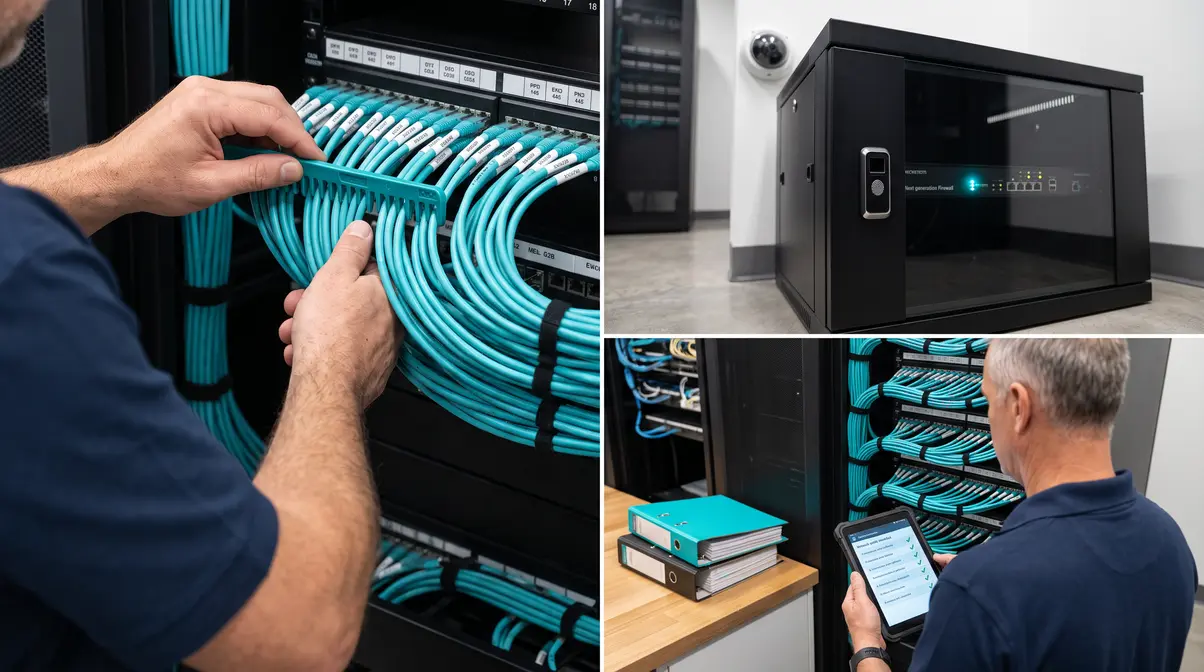
A clean rack is impossible without a well-planned cabling strategy. This foundation is so important that we consider it a specialised discipline. A professional comms cabinet setup depends entirely on a solid foundation, which is why a robust Structured Data Cabling Perth: Future-Proof Your Office strategy is the essential first step. We exclusively use certified Cat5E or Cat6 Ethernet cable from reputable manufacturers. We consistently encounter issues caused by cheap, non-certified cable and poor quality connectors, which lead to packet loss, slow speeds, and phantom network faults that can take hours of costly diagnostics to identify. Every cable, port, and device must be meticulously labelled. This discipline transforms a potential 4-hour fault-finding mission into a 10-minute fix.
Cable Management: From Spaghetti to Surgical Precision
Effective cable management is about more than just aesthetics; it’s critical for system longevity. A tangled mess of cables—often called “spaghetti”—restricts airflow, puts physical strain on ports, and makes any maintenance or upgrades a nightmare. Our technicians employ best practices:
-
- Horizontal & Vertical Managers: These dedicated components provide clean channels to route cables neatly. –
Separation of Power and Data:
- Power cables are run down one side of the rack and data cables down the other to prevent electromagnetic interference (EMI), which can degrade network performance.
- Velcro Over Zip Ties: We use reusable Velcro ties to bundle cables. Plastic zip ties, when overtightened, can crush the delicate twisted pairs inside an Ethernet cable, permanently damaging it.
Layered Security: A Defence-in-Depth Approach
As an integrated ICT and Security agency, we approach cabinet security with a multi-layered strategy. A simple lock and key are no longer sufficient. Securing the digital assets on your network starts with securing the physical hardware. This is where the convergence of our services provides a comprehensive defence for small business managers.
Physical Access Control: The First Line of Defence
Standard keyed locks offer minimal protection. We elevate this first layer by integrating the cabinet directly into your commercial Access Control system. By placing a card or fob reader directly on the rack door, you gain a full electronic audit trail of who accessed the cabinet and when. This is a powerful tool for compliance and incident investigation. Because we manage both the ICT network and the Access Control system, we can assure seamless integration—our “Single Point of Accountability” means you have one expert team managing the entire security ecosystem.
Physical Hardening and Tamper Detection
For high-security environments, we take physical protection a step further. We can anchor the cabinet directly to the concrete slab or a structural wall, preventing any attempt to physically remove the entire unit. Furthermore, we can install discreet door sensors on the cabinet that are wired into your building’s alarm system. While the alarm panel itself is not a network device, this integration means an unauthorised door opening can trigger an immediate duress alarm and notification. This level of physical hardening is a core component of a truly secure comms cabinet setup.
Environmental Monitoring and Surveillance
Threats aren’t always malicious. An air conditioning failure or a small water leak can be just as destructive as a burglar. We can install environmental sensors inside the cabinet to monitor for over-temperature, high humidity, or the presence of water, providing an early warning before catastrophic hardware failure occurs. To complete the security picture, we often recommend installing a dedicated CCTV camera with a clear view of the comms cabinet. Our high-quality CCTV systems provide clear, evidentiary-grade footage that supports accurate incident verification and liability protection, giving you indisputable video evidence of any activity around your most critical infrastructure.
The Importance of a Secure Room
Ultimately, a secure cabinet is only as strong as the room that contains it. The physical construction of the room, the quality of the door and lockset, and the overall site security all play a part. A holistic comms cabinet setup is a critical element within a wider security framework. This is why we always assess the entire environment, a process detailed in our comprehensive guide to Perth’s #1 Server Room Design & Maintenance | 2026 Guide.
Professional Installation: Avoiding Costly Mistakes
Executing a professional comms cabinet setup requires more than just technical knowledge; it demands skilled workmanship and respect for the client’s property. An amateur installation can lead to system unreliability and even physical damage to your building.
Our licensed and experienced technicians are trained to avoid damages to the building during installation. We understand that the installation complexity varies greatly between sites, from running exposed conduit on external brick walls to the more delicate task of feeding cables through concealed wall cavities in a finished office. A key part of our process involves a thorough site assessment to determine the safest and most efficient installation path. Often, we can leverage existing infrastructure, but this requires a careful evaluation to ensure it meets the standards required for modern, high-performance systems. All cabling work must be performed by a technician who holds the appropriate registration, in line with the registered cabler requirements set by the Australian Communications and Media Authority (ACMA).
Common Comms Cabinet Setup Mistakes We See in Perth
Across Perth, we’re often called in to fix issues stemming from a poor initial comms cabinet setup. These common mistakes create ongoing problems and increase operational risk for small business managers.
- No Room for Growth: The cabinet is completely full on day one, leaving no space for future upgrades without a complete and costly overhaul.
- The “Spaghetti Monster”: A chaotic mess of unmanaged cables makes troubleshooting nearly impossible and chokes off critical airflow.
- Cooking Your Equipment: Using a sealed, unventilated cabinet without fan units, leading to chronic overheating and premature hardware death.
- Inadequate Physical Security: Relying on a flimsy lock or, even worse, leaving the cabinet completely unlocked and accessible.
- Using Uncertified Cabling: Opting for cheap, non-certified cable and poor quality connectors to save a small amount upfront, resulting in intermittent network issues that are a nightmare to diagnose and disrupt business.
- Poor Power Management: A single, non-surge-protected power board daisy-chained and overloaded, with no UPS to protect against power fluctuations or outages.
Avoiding these pitfalls is simple with proper planning and professional execution, which is the cornerstone of our service.
Plan Your Professional Comms Cabinet Setup with Smart SYS
Your communications cabinet is the bedrock of your commercial operations’ technology and security. It deserves to be treated as the critical asset it is. A professional, secure, and organised comms cabinet setup is an investment that pays dividends through increased reliability, enhanced security, and simplified management.
At Smart SYS, we provide a complete, end-to-end service, from initial consultation and design to meticulous installation and ongoing maintenance. Our custom solutions are tailored to your specific commercial needs and budget. We focus on providing robust commercial systems where the comms cabinet setup and associated structured cabling have no or minimal ongoing monthly fees, assuring a clear return on your investment.
Don’t wait for a system failure or security breach to highlight the weaknesses in your infrastructure. Embrace our “Single Point of Accountability” and let our integrated team of ICT and Security specialists build a solution that you can rely on. Contact Smart SYS today to discuss how a professional comms cabinet setup can secure, streamline, and future-proof your Perth commercial operations.
Frequently Asked Questions
Why is a professional comms cabinet setup so important for my business?
A professional setup is crucial as your comms cabinet is the central hub for your entire operation, housing the hardware for your network, VoIP phones, CCTV, and access control systems. A well-planned installation prevents costly downtime, protects against security breaches, and simplifies maintenance, safeguarding your business’s continuity.
How much empty space should I leave in my new comms cabinet?
You should always plan for future growth. We advise clients to ensure at least 40-50% of the rack space remains free after the initial equipment is installed. This buffer easily accommodates future hardware, prevents overheating from overcrowding, and makes any future maintenance or upgrades much simpler.
What are the biggest mistakes to avoid with a comms cabinet installation?
The most common mistakes we fix across Perth include: choosing a cabinet that’s too small for future growth, creating a ‘spaghetti monster’ of cables that blocks airflow, using unventilated cabinets that cook the equipment, relying on a flimsy lock for security, and using cheap, uncertified cables that cause persistent network faults.
Does my comms cabinet need more than just a standard lock for security?
Yes, definitely. A basic lock is not enough to secure your most critical IT assets. We recommend a layered ‘defence-in-depth’ approach. This includes integrating the cabinet door with your commercial Access Control system for a full audit trail, installing tamper sensors linked to your alarm, and positioning a CCTV camera for visual verification of anyone accessing the rack.
Future-Proof Your Network’s Foundation
A tidy comms cabinet is more than just good looks—it’s the heart of your business’s security and performance. Don’t let tangled cables and outdated setups become a liability. Our expert team ensures your network infrastructure is secure, scalable, and ready for whatever comes next.


Post Comment