IT Downtime Costs: 2026 Guide for Perth Logistics & Retail

IT downtime costs can cripple operations fast. Discover 2026 financial benchmarks and proactive network protection for Perth logistics and retail.
IT downtime costs for Australian small-to-medium enterprises average between $420 and $4,500 per hour, driven by direct sales halts, idle operational payroll, recovery expenses, and immediate supply chain SLA breach penalties.
📌 Executive Summary & Key Technical Takeaways
- Financial Impact: Unplanned outages cost Perth commercial operations hundreds to thousands of dollars per hour through lost POS transactions, disrupted logistics dispatch, and non-productive staff overheads.
- Infrastructure Standard: Robust business continuity requires ACMA-compliant, certified Cat5E or Cat6 Ethernet cable backbones combined with commercial-grade switches to assure evidentiary-grade surveillance streams and VoIP stability.
- Unified Accountability: Modern commercial electronic security and ICT share unified transport networks; our Dual-Engine approach prevents multi-contractor finger-pointing when critical links sever.
- Proactive Mitigation: Implementing automated 4G/5G failover routes, edge-recording surveillance, and structured recovery frameworks effectively slashes outage recovery intervals and downstream liability.
Table of Contents
IT Downtime Costs: A 2026 Warning for Perth Logistics & Retail
As specialists in architecting robust commercial networks and security systems across Perth, we are sounding an early alarm. The year 2026 represents a convergence point where increased reliance on digital logistics, just-in-time retail operations, and escalating cyber threats will create a perfect storm. For small business managers and commercial facility operators in Perth’s logistics and retail sectors, understanding the true nature of IT downtime costs is no longer an academic exercise; it is a critical component of strategic planning and survival.
The real danger isn’t just an isolated desktop going offline. It is the point-of-sale system that can’t process a single EFTPOS transaction during peak retail trading on a Saturday in Osborne Park. It is the automated distribution centre in Welshpool grinding to a complete halt, causing delivery SLAs to fail. It is the commercial security camera network failing to route live video during an active warehouse perimeter breach. In this comprehensive guide, we move beyond generic international surveys to explore the specific, interconnected vulnerabilities facing Western Australian enterprises. We unpack the hidden financial and operational risks of an outage and present a strategic framework for building resilient infrastructure—one that acknowledges the deep connection between your ICT and electronic security systems.
Uptime vs Downtime: Operational Availability Explained
In modern enterprise computing and telecommunication systems, system availability is measured by the ratio of uptime versus downtime. Understanding this distinction is vital for commercial facility operators evaluating vendor SLA targets and designing business continuity frameworks.
- Uptime: The duration in which core systems—including network routing, VoIP communications, cloud enterprise resource planning (ERP) platforms, and connected access systems—remain fully operational and accessible to personnel. Uptime is conventionally represented as “nines” of availability. For instance, 99% uptime allows for approximately 3.65 days of unplanned failure per year, whereas a high-availability architecture delivering 99.99% (“four nines”) limits unplanned system interruptions to under 53 minutes annually.
- Downtime: Any interval during which production infrastructure is degraded or fully offline, preventing employees, automated systems, or retail customers from completing transactions. Downtime splits into two categories:
- Planned Downtime: Scheduled maintenance, firmware deployments, and structured infrastructure overhauls executed during off-peak hours to minimise trade impact.
- Unplanned Downtime: Sudden infrastructure breakdowns caused by severing of uncertified cabling, core switch failures, power supply trips, external telco blackouts, or malicious cyber incidents.
When unplanned incidents occur, the delta between 99% and 99.99% availability represents thousands of dollars in commercial liabilities. Establishing high availability demands disciplined network design, dual-carrier failover lines, and robust physical cabling installations.
How to Calculate IT Downtime Costs: The Australian SMB Formula
Estimating operational losses should not rely on broad guesswork. To quantify financial exposure with precision, Australian organisations can apply a direct, four-variable calculation model:
Let us break down each component of this baseline equation:
- 1. Lost Hourly Revenue (LHR): (Total Gross Annual Revenue ÷ Total Annual Operating Hours) × Revenue Impact Factor (0.0 to 1.0) × Outage Hours. For an e-commerce distribution hub generating $5,000,000 annually over 2,500 operating hours, an outage halting 100% of dispatch operations exposes the business to $2,000 per hour in lost throughput.
- 2. Staff Downtime Payroll (SDP): Number of Disrupted Personnel × Average Fully Loaded Hourly Rate × Outage Hours. If 25 logistics workers earning an average loaded wage of $40 per hour sit idle because dispatch scanners and warehouse management databases are inaccessible, payroll leakage totals $1,000 per hour.
- 3. Direct Recovery Fees (DRF): Emergency commercial field technician dispatch rates, expedited hardware procurement, emergency configuration hours, and overtime payroll required to restore damaged configurations.
- 4. Breach and Contractual Penalties (BCP): Immediate carrier detention charges, customer SLA failure fines, perishable product spoilage, and regulatory reporting administrative costs under ACCC compliance standards.
By compiling these measurable parameters, facility directors quickly discover that even an apparently minor two-hour outage routinely commands total damages exceeding $8,000 to $15,000 for a mid-sized Perth operation.

Beyond the Obvious: The Tangible vs. Intangible IT Downtime Costs
When a critical system fails, the immediate financial bleed is obvious. However, small business managers who only focus on this direct impact are missing the more insidious, long-term damage. At Smart SYS, we encourage our clients to categorise these impacts to fully grasp the severity of what’s at stake. The complete picture of IT downtime costs is a combination of what you can count and what you can only feel after the fact.
The Tangible Costs (The Ones You Can Count)
These are the figures you can plug into a spreadsheet. They represent direct, measurable financial losses incurred during and immediately after an outage. For a logistics firm or a retail store in Perth, these are painfully acute.
- Lost Revenue & Sales: This is the most straightforward calculation. If your POS terminals or e-commerce website are down, you are not making money. A simple formula is to take your average hourly revenue and multiply it by the number of hours of downtime. For a busy retail outlet, a few hours of an outage on a Saturday can wipe out a significant portion of the week’s profit.
- Lost Productivity: Every staff member unable to perform their duties is a direct cost. Your team might be on-site, but if their VoIP phones, collaboration tools, or access to network files are unavailable, they are effectively being paid to wait. This cost multiplies with every employee affected.
- Recovery & Repair Costs: Getting systems back online often involves emergency call-out fees from technicians, potential overtime for your own staff, and the expedited purchase of replacement hardware. These unplanned expenses can demolish a quarterly budget.
- Compliance Penalties & SLA Breaches: For logistics and supply chain operators, failing to meet a Service Level Agreement (SLA) due to downtime can result in direct financial penalties from your clients. Furthermore, ongoing failures can put you in breach of obligations related to Australian Consumer Law and ACCC guidelines, especially if they impact customer transactions or prompt business disputes. Understanding whether your current vendor contracts hold water is critical; explore our analysis on whether your Perth IT SLA is fit for purpose.
The Intangible Costs (The Silent Killers)
These are the costs that don’t appear on an invoice but can cause far more lasting damage to your commercial operation. The true, long-term IT downtime costs are often found here.
- Reputational Damage: A customer who tries to visit your Perth retail storefront and finds the payment systems down may walk to a competitor. A distribution client whose shipment is stranded because your warehouse tracking system stalled will question your operational integrity. In the digital age, these negative experiences quickly translate into poor online reviews and a tarnished brand reputation that can take years to rebuild.
- Decreased Staff Morale: Constantly battling with unreliable technology is immensely frustrating for your team. It creates a stressful work environment, leads to burnout, and accelerates staff turnover. High turnover, in turn, introduces substantial recruitment, onboarding, and training expenses.
- Missed Opportunities: Downtime doesn’t just pause current operations; it prevents new pipelines from moving forward. A sales team cannot capture qualified inbound commercial leads. Dispatch teams cannot process urgent freight manifests. Your operational agility—a key advantage for agile Perth businesses—is completely nullified.
- Data Loss: The ultimate intangible cost. Depending on the cause of the outage (such as mechanical drive failures or ransomware infections), critical commercial records can be lost permanently. Mitigating this risk requires disciplined continuity protocols; review our comprehensive Perth business continuity and IT disaster recovery guide for detailed implementation standards.


The Integrated Failure Point: When IT Downtime Cripples Your Security
Herein lies the single biggest misunderstanding we encounter among small business managers and commercial facility operators. They compartmentalise their thinking: “ICT” is computers, switches, and telecommunication lines, while “Security” is cameras, access panels, and intruder alarms. They calculate potential IT downtime costs solely based on the ICT side of the equation. This is a critical operational mistake. In a modern, connected commercial facility, your ICT and electronic security systems share the same transport layer. They are two engines on the same aircraft.
This is where our “Single Point of Accountability” model becomes indispensable. When an incident occurs, you cannot afford to have a commercial security technician blaming the IT contractor, who in turn blames the telecommunications provider. This finger-pointing blame game only serves to prolong outage durations and inflate aggregate downtime costs.
How a Network Outage Creates a Security Black Hole
Consider the scenario of an unmanaged network switch failing in your communications rack. While desktop internet access drops instantly, the physical operational consequences are far more severe:
Related Commercial Analysis:
IT Disaster Recovery Perth: 2026 Business Continuity Guide
- Commercial CCTV Systems Go Blind: High-quality commercial CCTV systems provide clear, evidentiary-grade footage that supports accurate incident verification and liability protection. IP cameras and Network Video Recorders (NVRs) rely directly on your local area network. When network hardware freezes or cables fail, remote monitoring terminates and centralised evidentiary streams drop. If a break-in, worker injury, or goods damage incident occurs while the network is offline, the lack of recorded footage creates enormous legal and liability exposures.
- Commercial Access Control Fails: Commercial access control door controllers rely on IP communications to validate credentials, update permissions, and log site movements. A catastrophic local network collapse can trigger two hazardous scenarios: doors defaulting locked (trapping personnel or preventing emergency response teams from reaching critical plant equipment), or fail-safe strikes unlocking without supervision, leaving commercial warehouse stock cages vulnerable to internal theft.
- Commercial Alarms Lose Primary Signalling: Standalone commercial alarm panels are engineered with dedicated circuit boards and are not network devices themselves; however, their modern reporting paths rely heavily on IP network signalling to connect with 24/7 central monitoring stations. When local switches or router gateways crash, the alarm panel may sound local external sirens during an intruder event, but its IP line to monitoring operators is severed. Without configured cellular failover paths, emergency dispatches cannot take place.
Architecting Resilience: A Proactive Defence Against IT Downtime Costs
The conversation around IT downtime costs must shift from a reactive, post-mortem calculation to a proactive, architectural strategy. While no provider can guarantee zero operational risk, we engineer resilient infrastructure designed for robust Risk Mitigation and maximum system survivability. This forms the foundation of our work at Smart SYS: architecting systems for consistent uptime, operational endurance, and ACCC compliance.
The Foundation: Robust Physical Network Infrastructure
Your enterprise digital operation—from a critical VoIP telecommunication line to high-throughput commercial CCTV feeds—is only as reliable as its underlying physical topology. Discover how we design compliant, enterprise-grade backbones through our specialised network infrastructure design and cabling services.
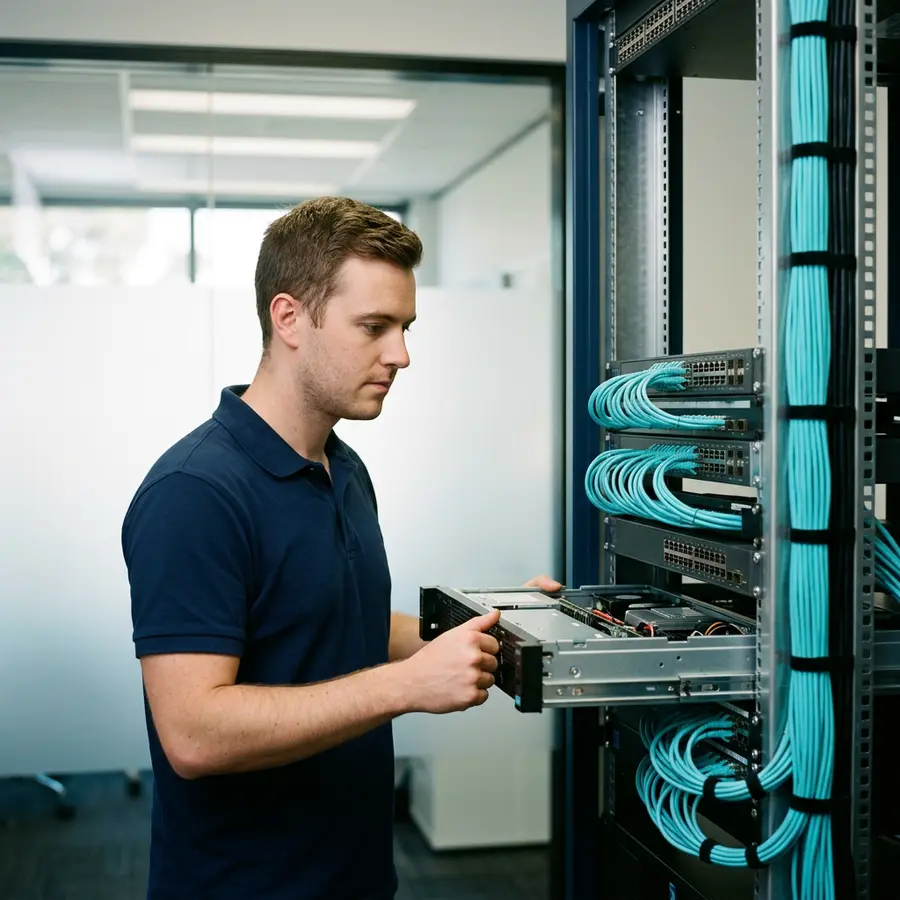
- Certified Structured Cabling: The backbone of any commercial enterprise is the physical cabling within structural risers and ceiling plenums. We exclusively deploy certified Cat5E or Cat6 Ethernet cable. Installations built using substandard, non-certified copper-clad aluminium (CCA) cables regularly suffer from micro-packet drops, signal crosstalk, and thermal failure under PoE loads. These hidden flaws create intermittent, phantom dropouts that cost thousands of dollars in diagnostic technician fees. All telecommunications cabling in Australia must be executed by an ACMA-registered cabler to assure strict compliance with national safety and operational standards.
- Commercial-Grade Switching and Routing: Consumer-grade routers and unmanaged switches purchased from retail outlets cannot handle the heavy packet throughput demanded by concurrent VoIP telephony, cloud synchronisation, and multi-stream video surveillance. Commercial-grade managed hardware provides quality of service (QoS) bandwidth management, rapid spanning tree protocol (RSTP) for loop prevention, and hardware-level isolation across dedicated VLANs.
Our Dual-Engine Approach to System Design
We architect facilities through our Dual-Engine model, uniting ICT Services and Security Services under a single engineering umbrella. This joined approach embeds redundancy across both functions:
- Resilient ICT Services: Our solutions for Telecommunication, VoIP, and business network architecture focus on removing single points of failure. We implement dual-WAN routers with automated 4G or 5G cellular failover. If an excavator severs the physical fibre line servicing your commercial park, traffic seamlessly shifts to cellular backup in seconds, preventing POS interruptions and telephone outages.
- Hardened Security Services: We design commercial surveillance networks with intelligent local survivability. We select commercial cameras supporting local edge storage (onboard industrial-grade SD cards). If connectivity to the central NVR drops during a network switch reboot, cameras continue logging evidentiary footage locally, automatically backfilling missing streams to the NVR once the network recovers. Similarly, access control panels are configured with autonomous onboard memory so local door validation continues unimpeded regardless of upstream server availability.
The Smart SYS Difference: Installation, Integration, and Accountability
Even the most advanced operational design fails if executed carelessly. At Smart SYS, our methodology combines professional installation standards with single-point administrative responsibility, offering small business managers complete certainty over their operational tech stack.
Professional Installation: Precision and Preservation
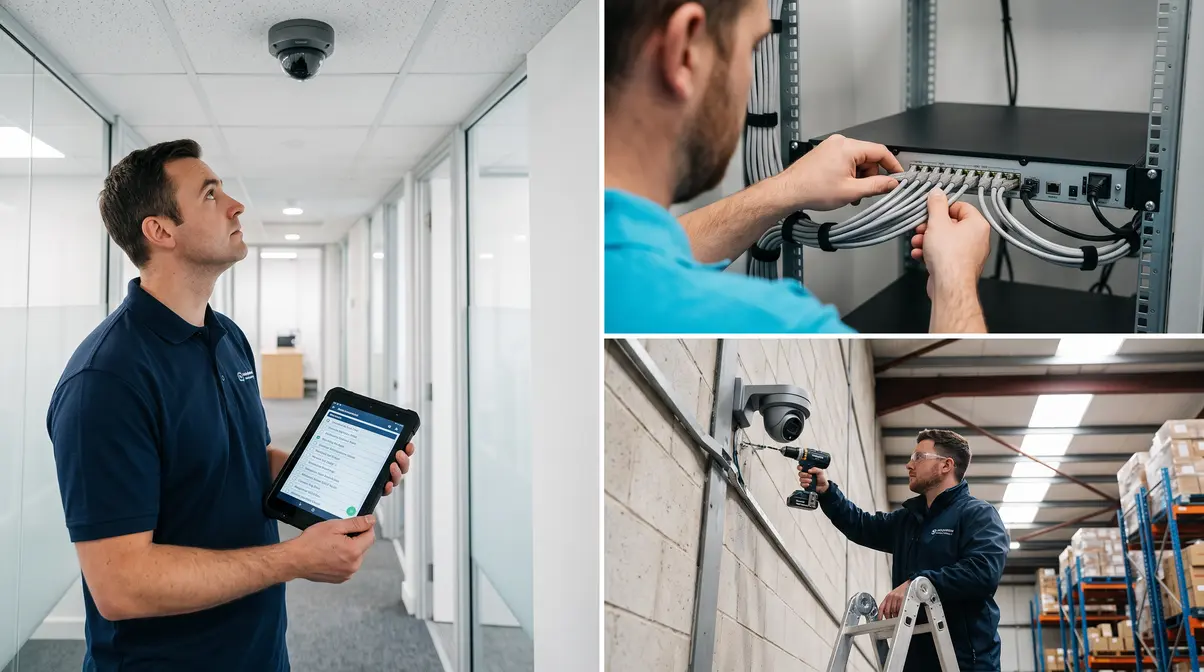
Our technicians are experienced trades professionals who understand how to operate inside finished commercial facilities, active warehouses, and boutique retail spaces:
- We route cabling meticulously to avoid damages to the building, taking extreme care around heritage structures, architecturally designed retail ceiling features, and structural warehouse panelling.
- We manage installation complexity across all physical environments, whether navigating industrial galvanised conduit across warehouse walls or fishing Cat6 drops through restricted double-brick cavities.
- When clients wish to leverage existing infrastructure, our technicians perform thorough cable qualification and attenuation testing before deployment. We never assume uncertified legacy runs can carry modern network traffic; we test, certify, and re-terminate where required to assure network integrity.
The Single Point of Accountability: Ending the Blame Game
When you partner with Smart SYS, your organisation eliminates cross-vendor friction entirely. If an unexpected event disrupts communications across your IP cameras, desktop workstations, or VoIP phone lines, you make one call. Our technicians are cross-trained across both ICT networking and commercial security infrastructure. We isolate and resolve the root issue immediately—whether resolving a PoE port delivery issue, correcting a gateway routing conflict, or replacing damaged infrastructure. By eliminating finger-pointing, we substantially compress resolution timelines, directly curtailing your exposure to runaway IT downtime costs.

Related Commercial Analysis:
Ultimate High-Density Wi-Fi Design for Perth Warehouses 2026
Calculating Your Own IT Downtime Costs: A Perth-Focused Worksheet
To quantify your risk exposure today, walk through this practical commercial audit worksheet with your management team:
Step 1: Calculate Your Hourly Revenue
Divide your weekly gross revenue by your actual weekly operating hours. This calculation establishes your baseline revenue exposure for every sixty minutes your operational systems drop offline.
Step 2: Map Your Critical Failure Dependencies
Identify systems that immediately impair revenue collection, logistics dispatch, or regulatory compliance if knocked offline:
- Retail Point of Sale (POS) and EFTPOS card gateways
- Telecommunication systems, VoIP trunks, and unified dispatch communications
- E-commerce transaction platforms and cloud CRM access
- Warehouse Management Systems (WMS), barcoding, and automated freight manifests
- Commercial CCTV surveillance systems and physical access control controller panels
- Local file stores, inventory databases, and dispatch management servers
Step 3: Quantify Payroll Exposure
Multiply the number of on-site staff unable to fulfil operational responsibilities during a complete network blackout by their loaded hourly rate. Include warehouse personnel, store clerks, dispatch planners, and back-office administrative teams.
Step 4: Factor in Second-Tier Intangible Risks
Account for client retention risks, negative customer reviews, freight rescheduling surcharges, and emergency contractor call-out fees. The cumulative figure illustrates why proactive investments in managed redundancy are a critical balance-sheet defence.
Your Next Step: Moving from Vulnerability to Resilience
The warning for Perth’s logistics, warehousing, and retail sectors is unequivocal: the financial, legal, and operational consequences of unmanaged network failures continue to climb. Relying on an outdated, reactive “break-fix” approach leaves your organisation severely exposed to crippling IT downtime costs.
Smart SYS delivers the proactive solution through our unified Dual-Engine model. As your Single Point of Accountability, we eliminate contractor confusion and deliver rapid, end-to-end resolution. From certified Cat6 Ethernet cable deployment to high-availability network routers and commercial electronic security integrations, we build systems designed for long-term operational resilience. Furthermore, we architect commercial systems that operate with no or minimal ongoing monthly fees, ensuring predictable cost of ownership and transparent returns on investment.
Do not wait for a catastrophic system blackout to reveal the true cost of unmanaged downtime to your business. Reach out to the team at Smart SYS today to arrange a comprehensive network and commercial electronic security audit of your facility.
Frequently Asked Questions
How much does IT downtime typically cost an Australian business?
For Australian small-to-medium enterprises, unplanned IT downtime generally costs between $420 and $4,500 per hour. The overall expense is determined by lost sales transactions, idle employee payroll, emergency recovery call-outs, and potential contractual SLA breach penalties.
How does an IT network outage affect commercial electronic security?
Modern commercial CCTV, door access control, and alarm signalling typically share the physical ICT network layer. When core switches or internet gateways fail, evidentiary camera streams drop, door permissions can become restricted, and primary alarm reporting paths to monitoring centres are severed.
What infrastructure steps best protect against unplanned network outages?
Resilience is improved by installing ACMA-compliant, certified Cat5E or Cat6 structured cabling, utilising managed commercial switches with quality-of-service rules, implementing automated 4G/5G secondary failover links, and deploying security cameras equipped with edge SD recording.
Why is a single point of accountability beneficial for ICT and security systems?
Unifying ICT and physical security under one engineering partner prevents cross-contractor blame when shared network infrastructure fails. Cross-trained technicians can identify whether an outage stems from routing faults, cabling, or hardware issues, significantly shortening resolution times.
Protect Your Perth Logistics & Retail Operations from Costly Downtime
Don’t let network outages stall your supply chain or disrupt POS terminals. Book an on-site infrastructure assessment with our Perth-based engineers to eliminate single points of failure.
Post Comment